

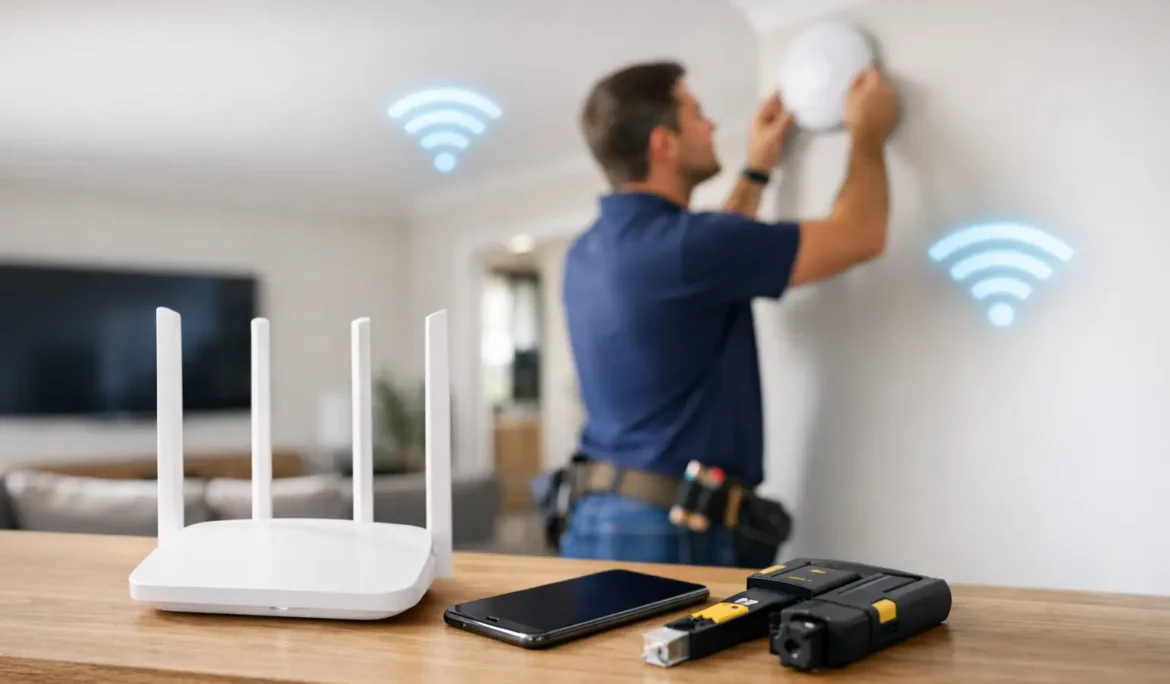
If your video call drops when you walk upstairs, your streaming stalls in the family room, or smart devices go offline for no obvious reason, the issue usually is not your internet plan alone. In many homes, the real problem is poor whole home wifi installation – a network setup that was never designed for the size, layout, materials, and device load of the property.
A strong home network should feel invisible. You should be able to stream, work, game, control lighting, manage security devices, and move from room to room without thinking about signal bars or dead zones. That kind of performance rarely happens by accident. It comes from planning, proper equipment selection, and installation that treats Wi-Fi as part of the home’s infrastructure rather than an afterthought.
What whole home wifi installation actually means
Whole home wifi installation is the process of designing wireless coverage for the entire property instead of relying on a single router in a random closet or corner office. The goal is consistent performance across the spaces where people actually live – bedrooms, kitchens, patios, media rooms, home offices, and anywhere smart devices need to stay connected.
In practice, that often means using multiple access points placed in strategic locations so devices can connect to the strongest signal as you move through the home. It may also include network switches, structured wiring, proper equipment mounting, and thoughtful configuration so the system performs well under daily use.
This is where many homeowners run into frustration. A network can appear fine during a quick speed test in one room and still perform poorly across the rest of the house. Coverage, capacity, interference, and placement all matter. So does how the network supports modern demands like 4K streaming, whole-house audio, smart home control, surveillance cameras, and work-from-home traffic happening at the same time.
Why one router is rarely enough
A single router can work in a smaller, simpler space. But many homes are not small or simple. Open floor plans, multiple levels, stone or tile surfaces, steel framing, dense insulation, and hidden utility areas can all weaken wireless signals.
Then there is the device count. A typical connected home no longer has just a few phones and laptops. It may include smart TVs, streaming boxes, tablets, gaming consoles, thermostats, lighting systems, shades, doorbells, cameras, voice assistants, appliances, and control platforms. Even if each device uses a modest amount of bandwidth, the total load changes what the network needs to handle.
That is why the right answer is not always “buy a stronger router.” More power does not solve poor placement or structural interference. In many cases, it creates a louder signal in the wrong place. A professionally designed system focuses on distributing coverage where it is needed rather than forcing everything through one piece of hardware.
The most important parts of a whole home wifi installation
The quality of the internet service coming into the home matters, but the in-home network design matters just as much. A good installation starts with understanding how the home is used. A family with multiple streaming zones, a dedicated home office, outdoor entertainment, and a growing smart home ecosystem needs a different design than a condo with light daily use.
Equipment placement is one of the biggest factors. Access points should be located to create overlapping coverage without crowding the network. That balance is important. Too few access points leave dead zones. Too many, or poorly placed ones, can create their own performance issues.
Wired connections behind the scenes are also important. The strongest whole-home wireless systems often rely on hardwired backhaul between access points. That gives the network a more stable foundation and reduces the compromises that come with wireless-only extension methods.
Configuration matters too. Proper SSID setup, channel planning, roaming behavior, security settings, and device segmentation all affect day-to-day performance. Homeowners may never see those details, but they feel the result when the network is easy to use and consistently reliable.
Whole home wifi installation for smart homes
As homes become more connected, Wi-Fi is no longer just about browsing and streaming. It supports core lifestyle systems. Lighting control, motorized shades, home automation platforms, distributed audio, smart TVs, security devices, and mobile app control all rely on a dependable network.
That changes the stakes. If the Wi-Fi is unstable, the smart home experience becomes frustrating fast. Delayed commands, unresponsive apps, camera dropouts, and inconsistent control can all trace back to network design. Homeowners often think a device is the problem when the network underneath it is actually the weak link.
For that reason, whole home wifi installation should be considered early in any renovation, new build, or major technology upgrade. It is much easier to create a clean, high-performance result when the network is planned alongside entertainment, automation, and control systems instead of being patched together later.
Common mistakes homeowners make
One common mistake is placing networking gear wherever the internet provider leaves it. That location is often convenient for installation crews, not for signal distribution. Another is mixing different Wi-Fi products over time – adding extenders here, a mesh unit there, and a replacement router later. The result can be a network that technically works but is inconsistent, difficult to manage, and full of weak points.
There is also a tendency to chase speed numbers while ignoring reliability. For most families, a stable connection throughout the house matters more than a very high speed reading in one room. Fast and fragile is not better than steady and usable.
Aesthetic concerns can create problems too. Networking equipment should not dominate a room, but hiding it in cabinets, utility enclosures, or behind dense materials can reduce performance. Good design respects both appearance and function.
What to expect from a professional installation
A professional approach begins with consultation and system design. The installer should ask how the home is used, where performance problems occur, what connected systems exist today, and what may be added later. This step matters because a network should fit the household, not just the floor plan.
From there, the equipment and placement strategy can be developed with purpose. In some homes, a few well-positioned access points are enough. In larger or more complex properties, the network may need a more advanced layout to support indoor and outdoor spaces, entertainment zones, and control systems.
Installation is only part of the job. Proper testing, tuning, and support are what turn good hardware into a dependable experience. That includes verifying coverage, adjusting settings, and making sure roaming behavior works the way it should when people move through the home with phones, tablets, and laptops.
For homeowners in New Jersey and New York who are investing in connected living, this is where working with a technology integration partner can make a real difference. Cine Acoustic approaches Wi-Fi as part of the full home experience, not as an isolated box on a shelf. That mindset helps create networks that support entertainment, automation, and daily convenience without adding complexity for the homeowner.
When whole home wifi installation is worth it
If your home has dead zones, buffering, unreliable smart devices, or patchy coverage outdoors, the need is fairly obvious. But even in homes where the network mostly works, an upgrade can still be worthwhile when expectations are rising. A new media room, expanded smart lighting, more work-from-home activity, or a larger device count can push an older setup past its limits.
It is also worth considering during renovation or construction, when wiring access and equipment placement can be planned more cleanly. The best results usually come when the network is treated as foundational infrastructure, similar to audio, video, lighting, and control.
The right system is not always the biggest or most complicated one. It is the one that fits the home, supports the way you live, and stays dependable as your needs evolve. That is what whole home wifi installation should deliver – not just more signal, but a better everyday experience with the technology you rely on most.