

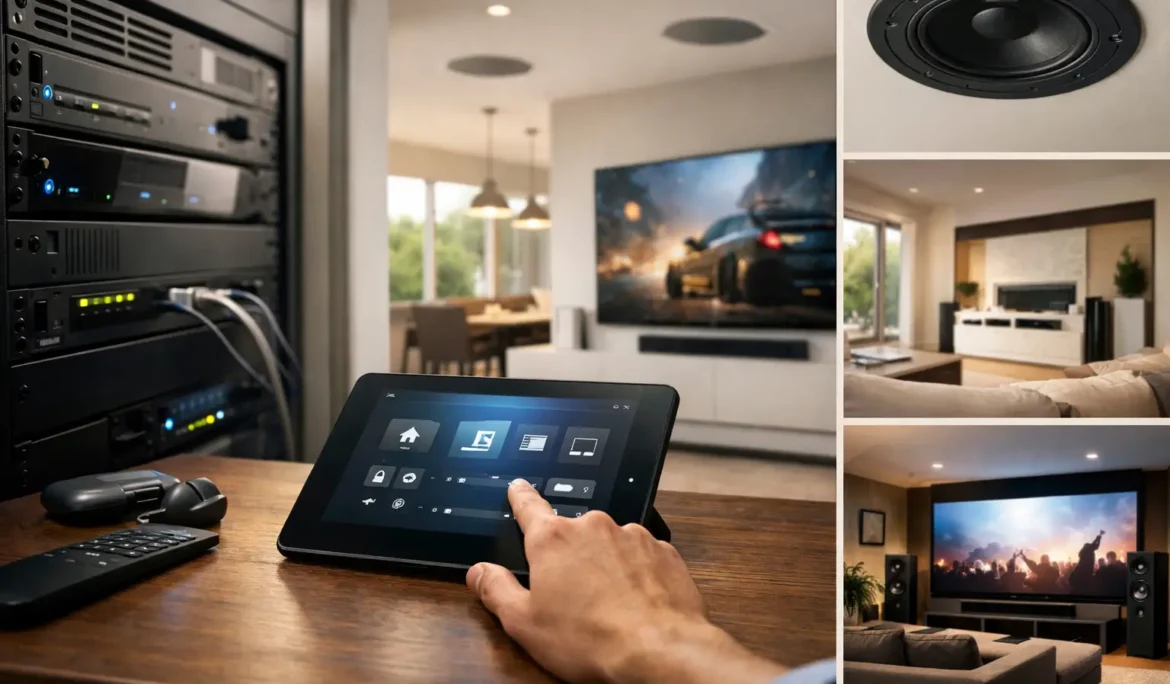
You feel the difference right away when a home is planned around entertainment instead of patched together one room at a time. A whole house audio video distribution system lets you start a movie in the family room, stream music to the kitchen, send the game to the patio, or keep kids entertained upstairs without juggling remotes, passwords, and mismatched devices.
For many homeowners, the real appeal is not having more gear. It is having fewer headaches. When the system is designed as one connected experience, the house feels easier to live in, cleaner to look at, and far more enjoyable to use.
What a whole house audio video distribution system actually does
At its core, this type of system shares audio and video sources across multiple rooms. Instead of placing separate cable boxes, streamers, and sound systems everywhere, selected source components are centralized and distributed where you want them. That might mean one dedicated rack feeding TVs throughout the home, whole-home music in key living areas, or both.
The benefit is control and consistency. You are not teaching every family member a different setup in every room. You are not hiding a stack of boxes behind each TV. And you are not guessing why one app works in one room but not another.
A well-designed system also keeps the experience flexible. One person can listen to music in the home office while another watches a movie in the media room and someone else streams a playlist outdoors. The rooms can work independently, or they can be grouped for parties, holidays, and everyday family life.
Why homeowners choose distribution instead of standalone rooms
Standalone entertainment setups often look simple at first. Buy a TV for each room, add a soundbar here, a streaming stick there, and solve problems as they come up. Over time, though, those piecemeal decisions tend to create clutter, uneven performance, and a lot of small frustrations.
A whole house audio video distribution system solves that by treating the home as one environment. The system can be customized around how you actually live, whether that means background music in the morning, sports on multiple displays during weekends, or a clean and quiet primary suite with hidden technology.
There is also an aesthetic advantage. Fewer exposed devices usually means fewer wires, fewer wall warts, and fewer visible compromises. For design-conscious homeowners, that matters just as much as sound quality or screen size.
The rooms that benefit most
The obvious spaces are family rooms, media rooms, bedrooms, kitchens, and patios. But the strongest systems usually support the way people move through the house, not just the rooms where a TV naturally fits.
For example, music in the kitchen and dining area changes how the home feels during everyday routines and gatherings. Audio in the primary bathroom or dressing area can make mornings more pleasant. Outdoor zones extend the experience beyond the walls of the house, which is especially valuable for homes built around entertaining.
Video distribution takes a more selective approach. Not every room needs every source, and not every display needs the same capability. That is where custom design matters. Some spaces need high-performance surround sound and cinematic picture quality. Others simply need easy access to live TV and streaming.
The technology matters, but design matters more
Homeowners often start by asking which brands to choose. That is a fair question, but it is not the first one. The more useful starting point is how the system will be used day to day.
A strong design process looks at the number of rooms, the types of sources you want to share, how often rooms will be used together, and who needs to control the system. It also considers the home itself – wall construction, equipment locations, Wi-Fi coverage, lighting conditions, and how visible or hidden you want the technology to be.
This is where many DIY or retail-driven setups fall short. On paper, the products may be compatible. In daily use, the experience can still feel awkward. Slow switching, app confusion, inconsistent audio, remote overload, and weak networking can make an expensive system feel unfinished.
Control should be simple
If a system needs a long explanation, it is not finished.
The best whole-home entertainment systems make advanced technology feel straightforward. That might mean a single app, in-wall touchscreens, handheld remotes, or a combination that fits the household. The goal is simple access to the things you use most: watch TV, play music, group rooms, adjust volume, and power spaces on or off without hunting through menus.
This is also why integration with home automation platforms can be so valuable. Entertainment works better when it is part of the larger environment. A tap can lower shades, set lighting, and start the movie. Outdoor music can be managed as easily as indoor music. The technology feels coordinated rather than layered on top of itself.
Audio quality is not just about speakers
Good sound depends on speaker selection and placement, but also on how the system is engineered. Ceiling speakers may be perfect for distributed music in open living areas. Dedicated architectural speakers may make more sense in rooms where better imaging and impact are important. Outdoor areas need products built for exposure and coverage, not just volume.
There is always a balance between performance and invisibility. Some homeowners want speakers to disappear into the architecture. Others want a more deliberate media experience in key rooms. Neither approach is wrong. The right answer depends on the room, the design priorities, and how critically that space will be used.
The same principle applies to video. A clean install is about more than mounting a screen. It includes sightlines, source access, control, cable management, and making sure the display works with the room rather than taking it over.
Networking is the foundation most people overlook
A whole-home entertainment system is only as reliable as the network behind it. Streaming services, control platforms, app-based sources, and connected TVs all depend on stable infrastructure. If the network is inconsistent, the entertainment experience will be inconsistent too.
That is why professional planning typically includes more than the visible equipment. Proper Wi-Fi design, wired connections where needed, and thoughtful equipment placement all support the performance homeowners expect. This is especially important in larger homes, renovated properties, and houses with outdoor entertainment zones.
When the network is treated as part of the system, everything works better. Source selection is faster. Streaming is more dependable. Control is more responsive. The homeowner should not need to think about any of that after installation.
New construction and renovation offer the most flexibility
You can add distributed audio and video to an existing home, but new construction and major renovation create more options. Wiring paths are easier to plan, speaker locations can be chosen with both acoustics and aesthetics in mind, and equipment spaces can be built intentionally instead of improvised later.
That said, retrofit projects can still deliver excellent results. The key is having a design strategy that respects the home. Sometimes that means prioritizing wireless control with selective hardwiring. Sometimes it means focusing on the rooms that will create the biggest lifestyle improvement first.
For homeowners in New Jersey planning a build or remodel, bringing in an integration specialist early usually leads to a cleaner result. It allows the entertainment system to coordinate with lighting, shading, and the broader smart home instead of competing with it.
Why professional installation changes the experience
The difference between products and a finished system is the part homeowners feel every day. Professional installation is not just about mounting displays or connecting speakers. It is about engineering a reliable experience, programming the controls, testing the handoff between rooms, and making sure the system is intuitive for everyone who uses it.
That service approach also matters after the installation is complete. Families change routines. Rooms change function. Streaming habits evolve. A trusted local partner can help the system adapt over time instead of becoming dated or frustrating.
At Cine Acoustic, that consultative approach is a major part of the value. Homeowners want guidance they can trust, recommendations that fit the home, and technology that feels polished from the first day of use.
Is a whole house audio video distribution system right for every home?
Not always in the same form.
Some homes need full audio and video distribution across many rooms. Others benefit most from whole-home music with selective video sharing. Some homeowners want high-performance entertainment in a few featured spaces and simpler access elsewhere. The right solution depends on the layout, the lifestyle, and the expectation for convenience.
What most homeowners want is not complexity. They want entertainment to be available where they need it, easy to control, and designed to fit the home. When that happens, the technology stops feeling like equipment and starts feeling like part of the way the house works.
The best time to think about whole-home entertainment is before the frustrations pile up. If you are already imagining how music, TV, and streaming should move through your home, that is usually the clearest sign that a better system is worth planning.