

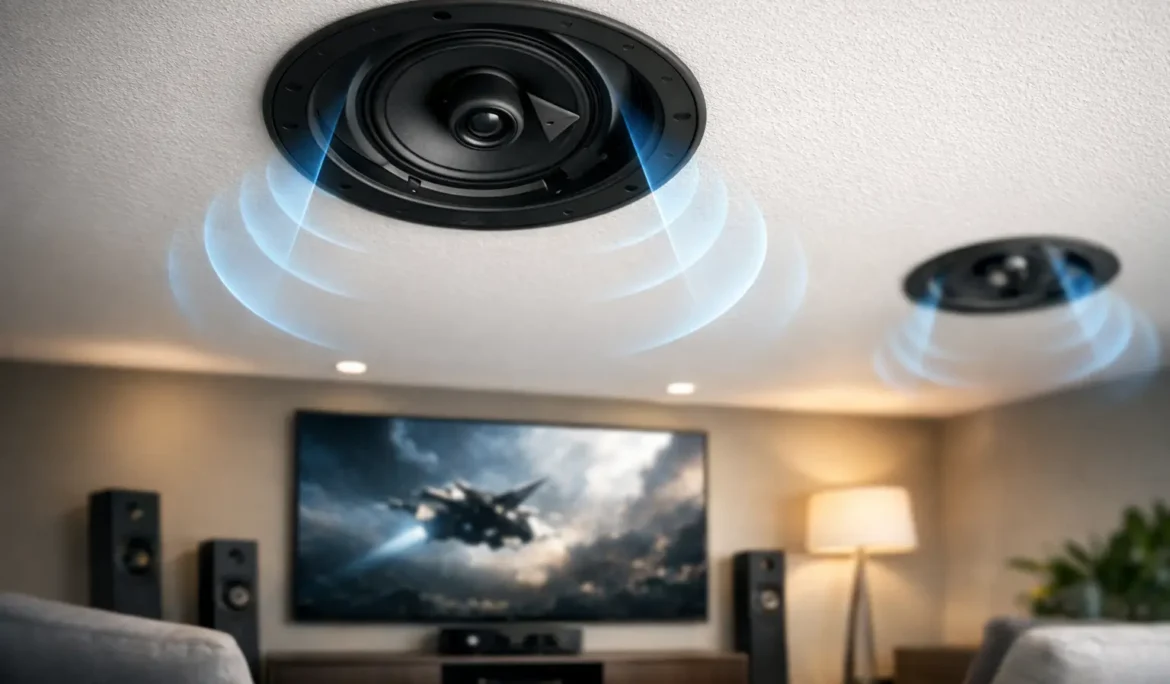
The difference between a good theater room and a truly convincing one usually happens overhead. A solid dolby atmos ceiling speaker guide starts there, because Atmos is not just about louder sound or more speakers. It is about placing effects in three-dimensional space so rain feels like it is above you, not just coming from the front wall.
That is where many homeowners get stuck. They know they want immersive sound, but they are not sure how many ceiling speakers they need, where those speakers should go, or whether in-ceiling models are even the right fit for the room. The right answer depends on the room, the seating layout, the construction, and the level of performance you expect from the system.
What Dolby Atmos ceiling speakers actually do
Traditional surround sound moves audio around you on a flat plane. Dolby Atmos adds height, which gives sound mixers another layer to work with. Instead of simply sending a helicopter effect to the rear speakers, the system can make that movement feel like it rises and passes overhead.
Ceiling speakers are one of the most effective ways to create that effect in a dedicated home theater or media room. While upward-firing Atmos modules can work in some spaces, they rely on reflected sound. That means the ceiling height, surface material, and room geometry matter quite a bit. Direct-radiating in-ceiling speakers are usually the more precise and consistent option when the goal is clear, believable overhead sound.
For homeowners who care about both performance and appearance, in-ceiling speakers also keep the room visually clean. That matters in spaces where the design needs to feel polished, not crowded with visible boxes and wires.
Dolby Atmos ceiling speaker guide: how many do you need?
The speaker count you need depends on the rest of the system. Atmos layouts are commonly written as three numbers. In a 5.1.2 system, the first number is the ear-level speakers, the second is the subwoofer count, and the third is the number of height speakers. A 5.1.2 setup has two overhead speakers. A 5.1.4 setup has four.
For smaller media rooms, two ceiling speakers can deliver a noticeable improvement over standard surround sound. If the room has a single main seating row and the dimensions are modest, a .2 Atmos layout often makes sense.
Four ceiling speakers usually create a more convincing sound field, especially in dedicated theaters or longer rooms. They allow better front-to-back movement overhead and tend to sound more balanced across multiple seats. If the goal is a premium cinematic experience rather than a basic upgrade, four height channels are often worth planning for from the beginning.
There are cases where adding more speakers is not automatically better. If the room is small, the seating is pushed against the back wall, or amplifier channels are limited, forcing a larger layout can create compromises elsewhere. Good design is about balance, not just quantity.
Placement matters more than most people expect
Speaker placement has a direct impact on whether Atmos sounds natural or distracting. The most common mistake is putting ceiling speakers too close to the walls or too far from the main listening area. That usually results in effects that feel vague or disconnected from the action on screen.
In most home theaters, Atmos ceiling speakers should be positioned relative to the primary seats, not simply centered in the room. If you are using two height speakers, they generally belong slightly in front of or around the main seating position, depending on the full system layout and room proportions.
With four speakers, the pair in front and the pair behind the listening area should create a balanced arc over the seats. This gives the processor enough information to steer sounds smoothly overhead instead of dropping them into obvious points.
Ceiling height also plays a role. Standard residential ceilings often work very well for Atmos. Very high ceilings can reduce the sense of precision unless the system is designed carefully. Sloped, coffered, or heavily detailed ceilings can also affect performance and may require adjusted placement or different speaker models.
This is one reason professional planning matters. On paper, a room may seem straightforward. In practice, lighting locations, joist direction, HVAC runs, and aesthetics all influence where speakers can go and how well they will perform.
Choosing the right type of in-ceiling speaker
Not all ceiling speakers are built for Atmos. Some are fine for background music but are not designed to deliver the clarity, output, and directional control a theater system needs.
For Atmos, speaker quality and voicing should complement the rest of the surround system. Ideally, the height speakers blend naturally with the front and surround channels so pans and effects feel cohesive. If the tonal character is too different, the illusion weakens.
Angled in-ceiling speakers are often a smart choice because they aim sound toward the seating area rather than firing straight down. That can improve imaging and intelligibility, especially when the speakers cannot be placed in a perfect location. Straight down-firing models may still work well in some rooms, but placement becomes even more critical.
Back boxes, enclosure design, and construction details also matter more than many people realize. They influence bass control, isolation, and consistency. In an open ceiling cavity, one speaker may perform differently from another simply because of what is around it behind the drywall.
The goal is not to overcomplicate the decision. It is to choose speakers that are meant for theater use and integrate properly with the rest of the system.
Room design can help or hurt Atmos performance
A well-designed room lets the audio system do its job. A poor room can limit even excellent speakers.
Hard, reflective surfaces can make overhead effects sound sharper than intended, while overly absorptive rooms may dull the sense of space. Seating placement matters too. If the main row is too close to the back wall, rear overhead effects have less room to develop. If seats are spread too wide, some listeners may sit outside the ideal coverage pattern.
Open-concept spaces present another trade-off. They can absolutely support Atmos, but the sound field may feel less defined than in a purpose-built room with stronger boundary control. That does not mean Atmos is the wrong choice. It just means expectations and system design should align with the space.
This is especially important during new construction or remodeling. Planning speaker positions before drywall goes up gives far more flexibility and usually leads to a cleaner result. It also helps coordinate lighting, shade pockets, HVAC, and other ceiling elements so everything works together visually and acoustically.
Installation decisions that affect long-term satisfaction
A ceiling speaker system should disappear into the room visually, but it should not be an afterthought behind the scenes. Wiring, bracing, grille alignment, and calibration all affect the final result.
Proper installation starts with infrastructure. The correct wire runs, equipment locations, and support for future upgrades can save major headaches later. Speaker cutouts need to be accurate, and grille placement should align with the room design rather than looking random across the ceiling.
Then there is calibration. Even well-placed speakers can underperform if levels, crossover settings, delays, and room correction are not dialed in correctly. Atmos relies on timing and spatial precision. If those details are off, the experience can feel flat or inconsistent.
This is why a turnkey approach often serves homeowners better than piecing together products from multiple sources. The system needs to be designed as one whole, with the room, speakers, electronics, and user experience all considered together.
Dolby Atmos ceiling speaker guide: when professional design makes sense
If you are adding Atmos to a true theater room, building a new home, or renovating a media space, expert design is usually the smarter path. The room may only give you one chance to get the ceiling speaker layout right.
A professionally designed system accounts for structure, aesthetics, listening goals, and ease of use. It also helps avoid the common result of many DIY Atmos projects: decent equipment installed in the wrong places.
For homeowners who want strong performance without technical guesswork, that guidance matters. Companies like Cine Acoustic focus on making advanced entertainment systems feel straightforward, so the final experience is not just impressive on day one but enjoyable to use every day.
The best Atmos rooms do not call attention to the technology. They let you sit down, press play, and feel the soundtrack expand above and around you the way it was meant to. If you are planning a theater or media room, treat the ceiling speaker plan as a core design decision, not a last-minute add-on. That is usually the difference between hearing more sound and feeling more immersed.