

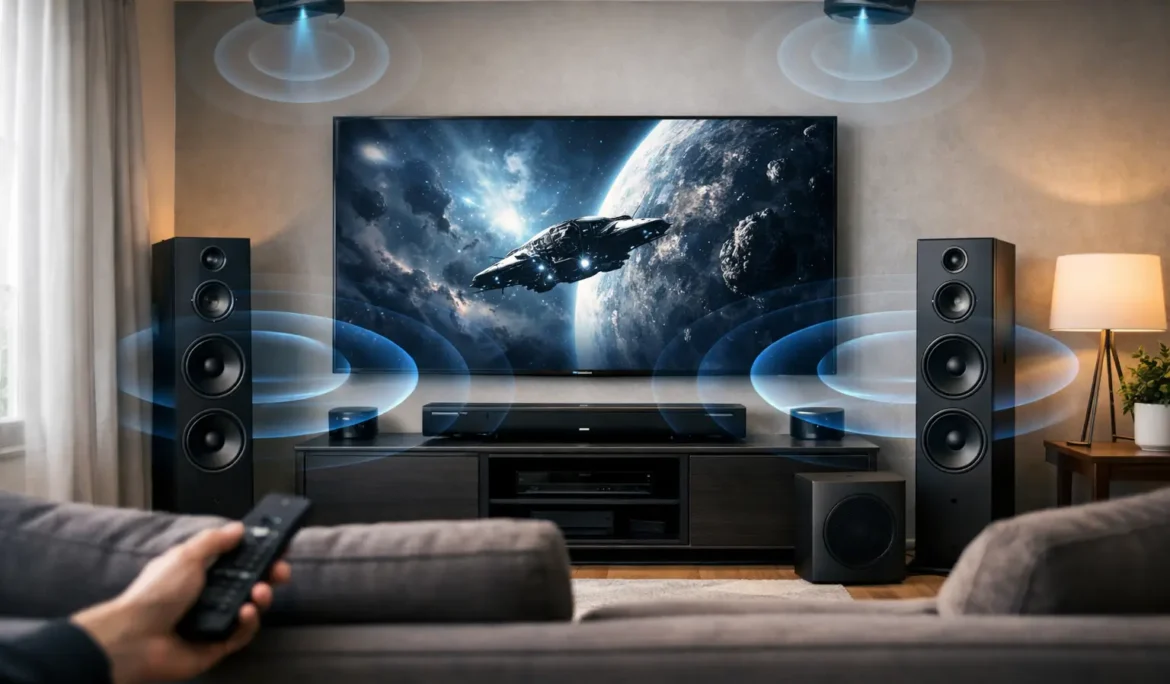
A helicopter moving from the screen to directly overhead should not sound like a speaker has simply become louder. It should feel like it has entered the room. That is the promise behind this Dolby Atmos home review: not another specification sheet, but an honest look at what immersive audio changes in a real living space and what it requires to perform at its best.
For homeowners creating a dedicated theater, upgrading a media room, or planning technology during a renovation, Dolby Atmos can be a meaningful improvement. But it is not a magic label. The results depend on room design, speaker placement, electronics, content, and the way your family actually watches and listens.
What Dolby Atmos Changes at Home
Traditional surround sound places effects around the listener using channels such as front left, center, front right, and surround speakers. Dolby Atmos adds height and object-based audio. Rather than assigning every sound only to a fixed channel, a soundtrack can tell the system where an object should appear in three-dimensional space.
That difference is easy to understand during the right scene. Rain can appear to fall above the seating area. A concert crowd can fill the room rather than stay trapped at the front of it. When an aircraft, racing car, or action sequence moves across the screen and overhead, the sound has a more convincing path.
The benefit is not limited to blockbuster films. Atmos can bring more scale to live performances, sporting events, games, and selected music releases. It also improves the sense of space in quieter moments. A well-mixed soundtrack may place subtle room tone, distant voices, or environmental effects around and above the audience, making the experience feel less like watching a screen and more like entering the scene.
Dolby Atmos Home Review: The Experience Is Real
When properly designed, Dolby Atmos earns its reputation. The height layer is not a novelty effect that calls attention to itself every few seconds. Its best work is often invisible: dialogue stays anchored to the screen, music expands naturally, and motion feels connected to what you see.
A quality system also improves clarity. The center channel carries much of a movie’s dialogue, while the surrounding and overhead speakers handle environmental detail and movement. With each speaker assigned a clear role, the room does not have to rely on two front speakers to do everything. This can make dialogue easier to follow without forcing the overall volume higher.
For families, that matters. A theater should be exciting during a Friday-night movie but still comfortable for a weekday show, a big game, or casual music. Atmos gives a properly calibrated system more room to breathe, especially at moderate listening levels.
There is a difference, however, between experiencing true Atmos and simply seeing an Atmos logo on a streaming app. The source material must include an Atmos mix, the playback equipment must pass it correctly, and the sound system must be capable of reproducing the height information. A strong system makes the most of great content, but it cannot turn every older stereo track into a native immersive mix.
Ceiling Speakers Deliver the Most Convincing Result
For homeowners who want the full effect, in-ceiling height speakers are usually the preferred approach. They create genuine overhead sound, which is particularly effective in a dedicated theater or a room with a clean, planned ceiling layout. They can also blend into the architecture with paintable grilles, preserving the room’s design.
Upward-firing speakers are another option. These modules bounce sound off a flat ceiling to create the impression of height. They can work in the right conditions, especially where cutting into a ceiling is not practical. But they are more dependent on ceiling height, ceiling material, seating position, and room geometry. Vaulted ceilings, exposed beams, and highly absorbent ceiling treatments can limit their effectiveness.
This is one area where a professional review cannot be reduced to a single product recommendation. A speaker that performs beautifully in a rectangular theater may be the wrong choice for an open-concept family room. The room should guide the system design, not the other way around.
More Speakers Are Not Automatically Better
Dolby Atmos configurations are commonly described with three numbers, such as 5.1.2 or 7.1.4. The first number represents ear-level speakers, the second refers to subwoofers, and the third indicates height speakers. A 5.1.2 system has five traditional surround speakers, one subwoofer, and two height channels. A 7.1.4 design adds rear surrounds and four height channels.
A larger layout can create more precise movement and broader coverage, but only when the room supports it. In a compact room, speakers placed too close together can blur the intended effect. In a wide room with multiple rows of seating, too few speakers can leave some listeners outside the immersive sound field.
Subwoofer performance deserves equal attention. Atmos provides the sense of height, but low-frequency impact gives a soundtrack weight. The opening of an action film, a concert drum kit, or the rumble of a distant storm will not feel complete if bass is weak, boomy, or uneven across the seating area. Careful placement and calibration are often more valuable than simply selecting a larger subwoofer.
The Room Matters as Much as the Equipment
Even excellent speakers cannot fully overcome poor acoustics. Hard floors, expansive glass, tall ceilings, and open adjoining spaces can make a room sound bright, echoey, or unfocused. On the other hand, excessive absorption can make the room feel lifeless. The goal is balance: controlled reflections, clear dialogue, and enough energy to keep films and music engaging.
Furniture placement also matters. A sofa pushed against the rear wall can compromise surround effects. Seating positioned too far off-center may make one side of the room dominate. Ceiling fixtures, vents, and architectural details may affect where height speakers can be installed.
These are not reasons to avoid Atmos. They are reasons to plan it as a system. A thoughtful design accounts for screen size, seating distance, speaker locations, cabinetry, lighting, window treatments, and control before equipment is selected. The outcome is more polished and more reliable because every component has a purpose.
Convenience Determines Whether You Use It
The best theater technology should not require a manual every time someone wants to watch a movie. An Atmos system often includes a display or projector, audio processor or receiver, multiple sources, streaming services, gaming consoles, and lighting. Without a unified control experience, that can become frustrating quickly.
A well-programmed control system can make the experience simple: select Movie Night, lower the shades, set the lights, turn on the appropriate components, and begin playback with the right audio mode. Family members and guests should not have to understand speaker layouts, HDMI settings, or remote-control sequences to enjoy the room.
Reliability is equally important. Inconsistent network performance can interrupt high-quality streaming, while poor source configuration can cause audio to fall back to a lower format. Professional installation brings value here because the system is designed, tested, calibrated, and supported as a complete environment rather than assembled from disconnected parts.
Who Should Choose Dolby Atmos?
Atmos is a strong fit for homeowners who want cinema-quality movie nights, enjoy gaming, listen to concert content, or are building a dedicated entertainment space. It is also ideal during construction or renovation, when speaker wiring and ceiling integration can be planned cleanly from the start.
It may be less essential for a room used mainly for background television, especially if the layout cannot accommodate proper speaker placement. In that situation, a high-quality surround system or carefully chosen soundbar solution may be the more practical choice. The right answer depends on the room, the desired level of performance, and how often the system will be used.
For clients who want a theater that sounds as considered as it looks, Cine Acoustic approaches Dolby Atmos as part of a complete home entertainment design. The objective is not to add complexity. It is to create an experience that works naturally from the first button press.
A great Atmos system should disappear when the movie starts. You should notice the tension of a quiet overhead creak, the crowd surrounding a championship moment, and the full impact of a favorite scene – not the equipment responsible for it.