

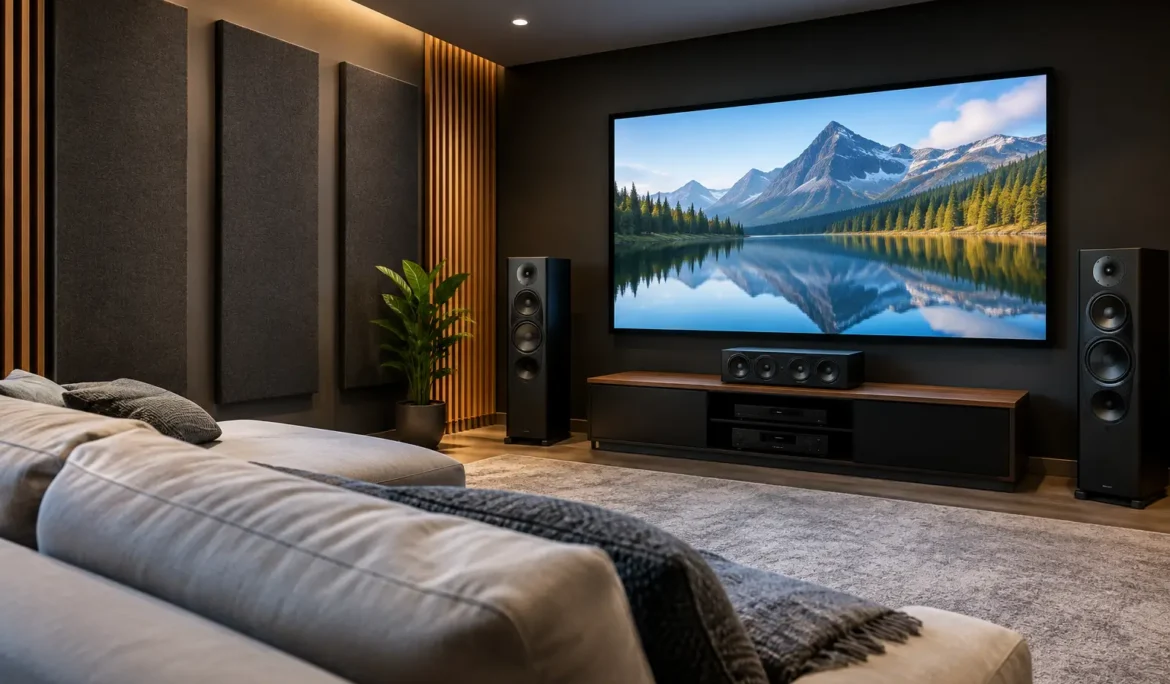
A great theater can have a large screen, premium speakers, and a powerful receiver, yet still sound disappointing if the room is working against the system. This home cinema acoustics guide explains the part of theater design many homeowners overlook: the space itself is as influential as the equipment inside it.
Sound waves do not stop at the speaker. They reflect from drywall, windows, flooring, ceilings, and furniture before reaching your ears. In an untreated room, those reflections can blur dialogue, exaggerate bass, and make surround effects feel less precise. The goal is not to create a room that feels silent or overly padded. It is to create a controlled, comfortable environment where every soundtrack is clear, balanced, and involving.
Start With the Room, Not the Equipment
The dimensions and finishes of a room establish its acoustic personality. A dedicated theater with enclosed walls gives you more control than an open basement or a multi-purpose family room, but both can deliver exceptional results when planned correctly.
Hard, parallel surfaces are usually the biggest challenge. A room with bare drywall, hardwood floors, glass doors, and a flat ceiling gives sound many places to bounce. Those early reflections can arrive just milliseconds after the direct sound from the speakers, reducing clarity and making the front soundstage seem less focused.
Room proportions also affect low frequencies. Bass waves are long and energetic, so they build up in some locations and disappear in others. You may hear a powerful rumble in one seat, then almost no impact a few feet away. This is why a subwoofer cannot simply be placed wherever it is least visible. Its location should be chosen as part of the room design and verified through calibration.
For new construction or a major renovation, acoustic planning should begin before framing is complete. Speaker locations, equipment placement, wiring paths, HVAC noise, recessed lighting, window treatments, and wall finishes all influence performance. Early coordination avoids the common compromise of trying to correct a room after every surface is already finished.
Control Reflections Without Making the Room Feel Like a Studio
Acoustic treatment is often misunderstood as covering every wall with foam. Residential theaters need a more thoughtful approach. The right combination of absorption, diffusion, and bass control improves sound while preserving the polished appearance expected in a finished home.
Absorption improves clarity
Absorptive panels reduce unwanted reflections, particularly at the first reflection points along the side walls and ceiling. These are the surfaces where sound from the front speakers reflects toward the primary seating position. Treating them helps dialogue stay anchored to the screen and allows music and effects to sound more distinct.
Fabric-wrapped acoustic panels can be selected to complement the room’s color palette, theater seating, or wall details. They may be integrated into decorative wall systems, behind acoustically transparent fabric, or into custom millwork. The treatment should support the design rather than make the room feel technical.
Carpet, upholstered seating, area rugs, and heavy drapery also contribute some absorption. They are useful parts of the overall solution, but they should not be treated as a replacement for purpose-built acoustic materials. A thick rug may reduce floor reflections, for example, but it will not solve a bass buildup in the rear corner of the room.
Diffusion keeps the room lively
A room with too much absorption can sound unnaturally dry. Diffusers scatter sound in many directions rather than simply absorbing it. They help preserve a sense of spaciousness and can be especially effective on rear walls or other surfaces farther from the seating area.
Diffusion is not necessary in every theater. In a smaller room, there may not be enough distance between the listener and the diffuser for it to work as intended. In those cases, controlled absorption and careful speaker placement may be the better choice. The right approach depends on room size, seating layout, and the system’s performance goals.
Bass traps address the hardest problem
Low-frequency control is typically the most challenging part of a home theater. Bass traps are designed to reduce excessive energy that collects in room corners and boundaries. Proper bass management creates tighter, more consistent impact from explosions, musical scores, and deep effects without turning every loud moment into a muddy boom.
Because bass treatment needs depth and volume to work effectively, it is often integrated into front walls, rear corners, risers, or custom-built architectural elements. A professional design can make these solutions visually discreet while preserving valuable floor space.
Speaker Placement Is an Acoustic Decision
Speaker placement and room acoustics are connected. Even the best treatment cannot fully correct speakers that are aimed poorly, positioned too close to boundaries, or placed unevenly around the seating area.
The center channel deserves particular attention because it carries much of a film’s dialogue. It should be aligned as closely as possible with the screen and directed toward listeners, not placed low in a cabinet where furniture edges can block or reflect sound. An acoustically transparent projection screen can allow the left, center, and right speakers to sit behind the image, creating the natural impression that voices and action come directly from the screen.
Surround and Dolby Atmos speakers should be positioned according to the room’s geometry and the main listening area. Their purpose is not simply to make noise from every direction. Proper placement creates believable movement, from rain falling overhead to a vehicle passing from front to back.
Subwoofer placement should be tested rather than guessed. In many theaters, two or more subwoofers produce more even bass across multiple seats than one larger unit. This is especially valuable for families and guests, since a theater should sound engaging beyond one preferred chair.
Treat Noise as Part of the Experience
Acoustics is not only about what happens inside the theater. It also includes keeping outside noise from interrupting the experience and limiting sound transfer to other parts of the home.
Mechanical systems are a frequent source of distraction. Air vents, equipment fans, plumbing, and adjacent appliances can become surprisingly noticeable during quiet scenes. Thoughtful HVAC design, quiet ventilation strategies, isolated equipment locations, and appropriate construction details help keep the room comfortable without adding background noise.
Sound isolation is a separate discipline from acoustic treatment. Acoustic panels improve how a room sounds internally, while isolation reduces sound traveling through walls, ceilings, doors, and structural framing. If the theater is near bedrooms, a home office, or a shared living area, isolation should be considered early in the project. Retrofitting it later is much more difficult.
Doors deserve careful attention as well. A lightweight hollow-core door can allow significant sound leakage, even in a well-designed theater. Solid construction, proper seals, and a well-fitted threshold can make a meaningful difference without changing the way the room is used.
Calibration Brings the Design Together
Once the room, speakers, subwoofers, and treatments are in place, calibration turns the individual components into one system. Measurements reveal issues that are difficult to identify by ear alone, including timing differences, crossover concerns, uneven bass response, and level inconsistencies between channels.
Automatic room correction can be helpful, but it is not a substitute for good design. Software can adjust signal levels and equalization, yet it cannot remove a harsh reflection from an untreated wall or fix a poorly located subwoofer. The best results come from sound acoustic fundamentals followed by precise system tuning.
A professional installation also considers how the theater will be used every day. The control experience should be simple enough that starting a movie does not require managing multiple remotes, changing inputs manually, or troubleshooting settings. Lighting scenes, shading, playback, and audio can be tailored around the way your household enjoys the space.
A Home Cinema Acoustics Guide for Real Homes
Not every room needs the same level of treatment. A dedicated cinema built for reference-level movie playback requires a different approach than a media room used for sports, family movies, and casual entertaining. The right solution balances room constraints, interior design preferences, listening habits, and desired performance.
For homeowners planning a theater or upgrading an existing entertainment space, the most useful question is not, “Which speaker is best?” It is, “How will this entire room work together?” Cine Acoustic approaches that question through coordinated design, installation, and calibration, so the finished space feels refined and remains easy to enjoy.
The best home theater acoustics are rarely the most noticeable feature in the room. They are the reason dialogue stays clear, bass feels controlled, and every seat pulls you deeper into the story.