

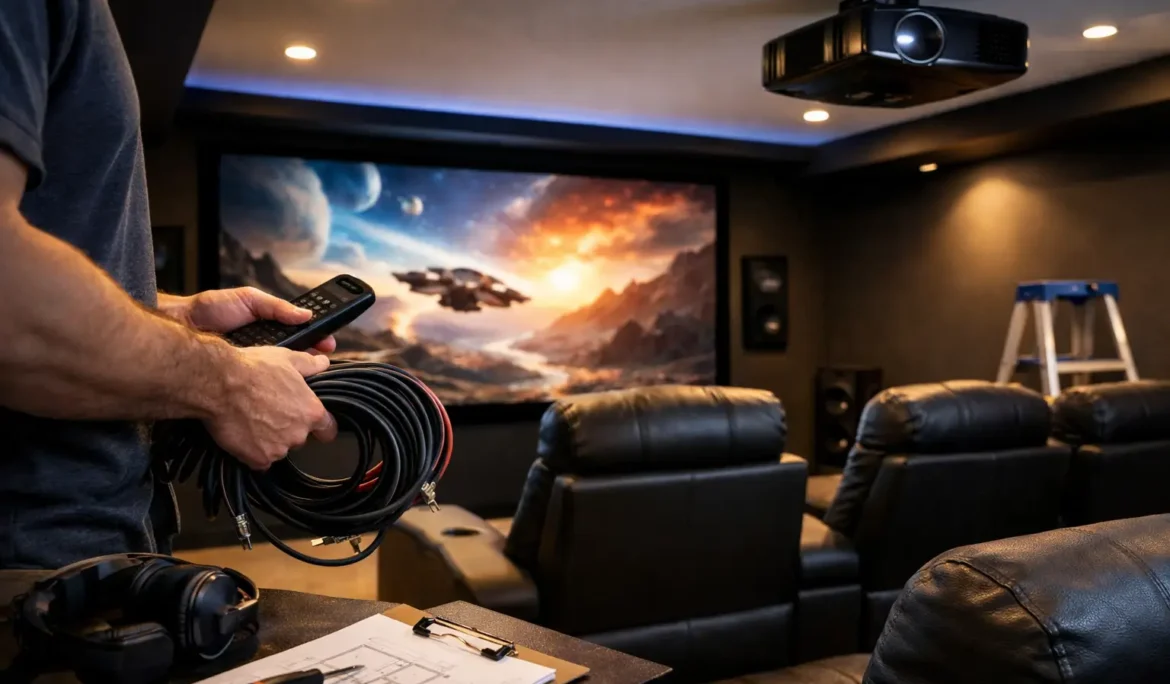
A great movie room is not defined by the number of speakers on the wall or the size of the screen. It is defined by what happens when the lights lower, the opening scene begins, and the room disappears around you. Home theater design and installation for immersive entertainment experiences brings picture, sound, lighting, and easy control together so your home feels ready for movie night, the big game, gaming, and everyday family entertainment.
For homeowners, the challenge is rarely finding equipment. The challenge is choosing technology that works beautifully in a specific room, suits the way the household actually watches, and remains simple enough for everyone to use. A thoughtfully designed theater does not ask you to manage a stack of remotes, troubleshoot connections, or compromise the appearance of a carefully finished space.
What Makes a Home Theater Feel Immersive?
Immersion comes from coordination. A large, clear image may be impressive, but it will not feel cinematic if dialogue is difficult to hear, the lights create glare, or a remote control requires a guidebook. Every element has a role, from room layout and speaker placement to the way the system starts.
Picture should match the room
The right display is determined by viewing distance, room dimensions, light levels, and viewing habits. In a dedicated theater with controlled lighting, a projector and screen can create a dramatic, large-scale presentation. In a multi-purpose family room with daytime viewing and windows, a premium television may deliver a better experience with brightness that holds up to ambient light.
Bigger is not always better. A screen that overwhelms the seating distance can make action scenes tiring to watch, while a display that is too small loses the impact homeowners expect. The goal is a comfortable field of view that draws viewers into the content without making the room feel like a showroom.
Sound creates the sense of place
Surround sound is what turns a good picture into an experience. With a properly planned Dolby Atmos system, voices stay anchored to the screen, music fills the room naturally, and effects move around and above the audience. You do not need to notice individual speakers for the sound to be effective. In fact, the best systems make the technology disappear.
Speaker locations, seating positions, room finishes, and bass management all affect performance. Hard floors, glass, and open layouts can make sound feel bright or unclear. A well-designed system accounts for those conditions from the beginning, using speaker choices and calibration that support clear dialogue and balanced impact at every seat.
Lighting protects the experience
Lighting is often overlooked until the first time a bright ceiling fixture reflects across the screen. Layered lighting makes a theater more comfortable and more functional. Recessed lights can provide general illumination, step or aisle lighting improves safety, and accent lighting gives the room character before and after the movie.
With lighting control, a single button can lower shades, dim the room, set the theater to the preferred source, and create the right viewing environment. This is especially valuable in rooms that serve more than one purpose. The same space can be bright and welcoming for conversation, then prepared for a film in seconds.
Home Theater Design and Installation Starts With the Room
The strongest theater projects begin before equipment is selected. A consultation should focus on how the room will be used, who will use it, and what needs to remain visually unobtrusive. A dedicated basement theater, a media room near the kitchen, and a living room shared with guests require different solutions.
In a dedicated space, there may be more freedom to use a projector, acoustically transparent screen, concealed speakers, and deeper bass performance. In a living area, discreet in-wall or in-ceiling speakers, a low-profile television installation, and motorized shades may be more appropriate. Neither approach is inherently better. The best choice depends on the architecture and the lifestyle of the household.
Planning during construction or renovation offers meaningful advantages. Wiring can be placed inside walls, speaker locations can be coordinated with ceiling details, and equipment can be housed away from the viewing area. But an existing room can also become an exceptional entertainment space with careful planning. The key is to assess the room honestly rather than force a standard package into it.
Installation Is Where Performance Becomes Reliable
A premium display and quality speakers can still disappoint when installation is treated as an afterthought. Proper mounting, clean cable routing, ventilation, network planning, and final calibration are essential to the long-term experience.
Equipment needs a place to live. Components such as AV receivers, media servers, streaming devices, and network hardware generate heat and require organized access for service. A professionally planned equipment location keeps the room clean while making the system easier to maintain. It also avoids the common problem of hidden equipment that becomes difficult to reach when a connection needs attention.
Network performance matters as well. Streaming services, high-resolution content, control systems, and connected devices all depend on stable Wi-Fi and wired connections. A theater should not become frustrating because the picture pauses during a crucial scene or a control command is slow to respond. Network design should support the entertainment system as part of the home, not as an isolated add-on.
Calibration completes the work. Video settings should be adjusted for the display and room lighting, while audio calibration balances speaker levels, timing, and bass response. This is the difference between equipment that is merely turned on and a system that performs as intended.
Simple Control Is Part of the Experience
A home theater should be approachable for every member of the family. If watching a movie requires selecting inputs, powering on several components in the correct order, and adjusting separate remotes, the room will be used less often than it should be.
An integrated control system can place the essentials in one intuitive interface. Pressing “Movie Night” can turn on the display or projector, select the desired content source, set the sound system, adjust lighting, and lower motorized shades. Controls can be tailored to the household, with clear labels and only the functions people need on a daily basis.
This approach also supports the way entertainment changes. A theater may include streaming platforms, cable or satellite programming, gaming consoles, a Kaleidescape movie player, music services, or whole-home audio. Bringing these sources together under one control experience keeps the system useful without adding complexity.
Decisions That Deserve Careful Thought
Some choices involve real trade-offs. A projector can deliver a grand image, but it benefits from controlled light and requires thoughtful screen selection. In-ceiling speakers may preserve a clean look, while dedicated surround speaker placement can provide more precise effects. A large subwoofer can create dramatic low-frequency impact, but room size, construction, and neighbors may influence what is appropriate.
It also helps to consider what will change over time. Families may add new content sources, finish adjacent rooms, or want the theater to connect with whole-house audio, lighting, or automation. Planning for expansion does not mean filling a room with features that will never be used. It means selecting a foundation that can adapt without requiring a major rework later.
A Theater Built Around Your Home
The most rewarding home theaters feel personal. They reflect whether you prefer intimate movie nights, serious sports viewing, concert films, gaming, or a flexible room where friends and family gather. Design details matter just as much as component specifications: sightlines from each seat, the height of the screen, where drinks can be placed, how easily the room transitions from entertaining to watching.
For New Jersey and New York homeowners, working with a local team such as Cine Acoustic brings design, installation, customization, and continued support into one coordinated process. That guidance helps ensure every choice serves the room and the people who use it.
The right theater is not the one with the longest equipment list. It is the one that invites you to press a button, settle in, and enjoy the moment without thinking about the technology at all.