

A beautiful home can still have one daily frustration – the upstairs Zoom call drops, the patio speaker buffers, and the theater room somehow gets the weakest signal in the house. When homeowners ask about mesh wifi vs access points, they are usually not asking a technical question. They are asking which solution will finally make the network feel reliable.
That distinction matters. Wi-Fi is no longer just for phones and laptops. It supports streaming, gaming, whole-home audio, video doorbells, smart lighting, shades, security devices, and automation systems that need to respond quickly and consistently. The right network should disappear into the background and simply work.
Mesh WiFi vs access points: the basic difference
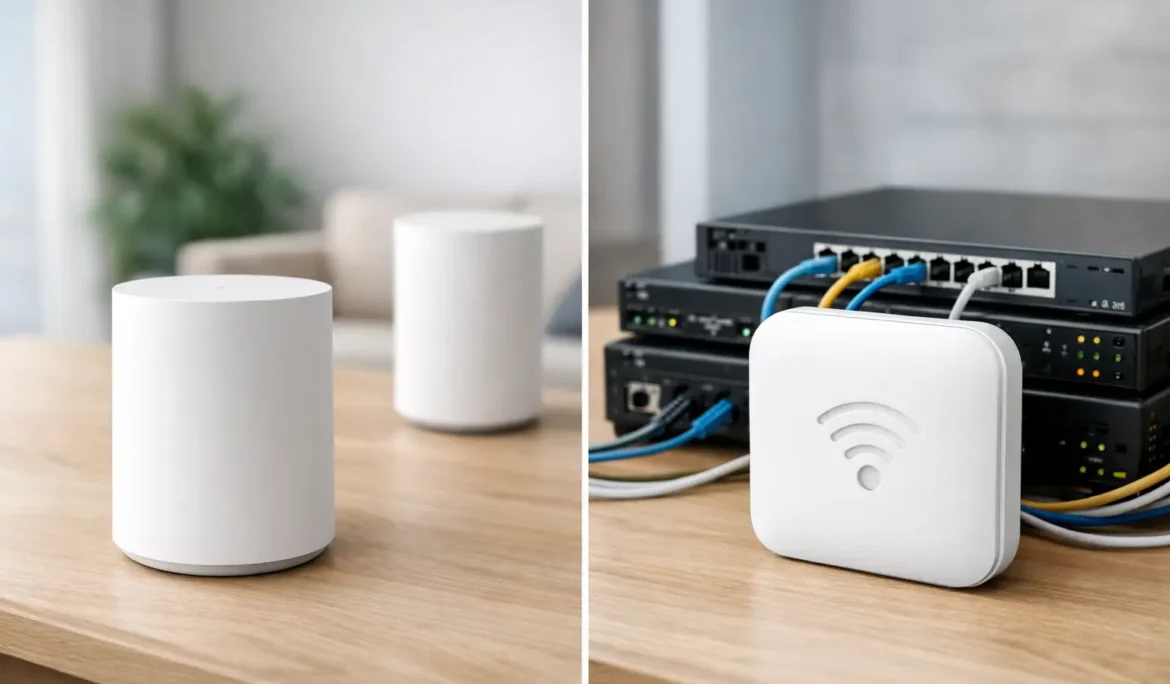
Mesh Wi-Fi and wireless access points both extend coverage, but they do it in very different ways. A mesh system uses multiple nodes that communicate with each other to spread Wi-Fi throughout the home. One unit connects to your modem or router, and the others are placed around the house to relay the signal.
Access points are different. They are wired back to the network and create Wi-Fi from fixed locations. Instead of passing traffic from one wireless node to another, each access point sends data directly through the home’s wired infrastructure.
That one difference shapes everything else. Mesh is often easier to place and can work well in homes where running cable is difficult. Access points usually deliver stronger performance, more stability, and better support for larger connected homes because each unit has a dedicated wired connection.
Where mesh Wi-Fi makes sense
Mesh has real advantages, especially for homeowners who want better coverage without opening walls or planning a larger network build. In the right environment, it can be a practical solution.
A mesh system is often a good fit for smaller homes, condos, or spaces where dead zones are limited and internet use is fairly typical. If the goal is mainly to improve signal in a few problem areas for web browsing, streaming, and general smart device use, mesh may get the job done with less disruption.
It can also be useful in homes where wiring options are limited. Because the nodes talk to each other wirelessly, placement is more flexible than with traditional access points. That flexibility is appealing when there is no structured cabling in place.
The trade-off is performance. Every time a mesh node relies on a wireless hop to pass traffic along, some efficiency is lost. In a modest setup, that may not be noticeable. In a larger home with heavy streaming, gaming, smart home activity, and lots of devices online at the same time, it often becomes noticeable very quickly.
Why access points are often the better long-term solution
For larger homes and more demanding systems, access points usually win. They provide more consistent coverage, faster speeds, and better reliability because each one is hardwired.
That matters when the home network is supporting much more than casual internet use. A modern connected home might include TVs streaming 4K content, a home office running video calls, a control system managing lights and shades, and wireless music playing in several rooms at once. In those environments, network stability is not a luxury. It is part of how the entire home functions.
Access points also give integrators more control over placement and design. Instead of plugging in nodes where there is convenient power, access points can be strategically located for the best coverage. That helps eliminate weak spots and creates a more even signal throughout the property.
For homeowners who care about aesthetics, access points are also easier to integrate cleanly. Ceiling-mounted or discreetly placed units are generally less intrusive than mesh nodes sitting on shelves, counters, or side tables.
Mesh wifi vs access points for speed and reliability
If speed and reliability are your top priorities, access points usually have the edge.
With mesh, the quality of the connection depends not only on the device you are using, but also on how well each node communicates with the next. Walls, flooring materials, appliances, and distance can all weaken that link. A system that looks great on paper may struggle in a home with stone, plaster, metal framing, or multiple levels.
Access points avoid much of that problem because they do not need to rely on a wireless backhaul between units. Their wired connection keeps performance more predictable. You still need proper design and placement, but the network has a stronger foundation from the start.
That is especially important in homes with outdoor entertainment areas, detached spaces, or rooms that are far from the main internet entry point. Extending reliable Wi-Fi to those areas is often much easier with professionally placed access points than with a chain of mesh nodes trying to reach across the property.
The hidden factor: how your home is built
Homeowners often compare products before looking at the house itself. In practice, construction details are a major part of the decision.
A newer open-concept home may allow a mesh system to perform reasonably well. A larger custom home with dense materials, multiple floors, and specialty spaces like media rooms, garages, and outdoor living areas places very different demands on the network.
This is why one homeowner can say mesh works perfectly while another has constant frustration with a similar product. The technology did not change. The environment did.
When network planning is done correctly, the layout of the home, the materials used in the walls, the number of devices, and the homeowner’s daily habits all shape the recommendation. That is one reason professionally designed Wi-Fi systems tend to perform better than one-size-fits-all solutions.
When mesh can disappoint
Mesh is often marketed as the simple answer to whole-home Wi-Fi, but simplicity has limits. The biggest issue is that adding more nodes does not always solve the problem. In some cases, it creates more wireless chatter and more opportunity for interference.
Another common issue is inconsistent roaming. Devices are supposed to move smoothly from one node to another as you walk through the home, but real-world performance varies. You may find a phone or tablet hanging onto a weaker connection longer than it should, even when a better signal is nearby.
That inconsistency can be frustrating in homes where dependable coverage is expected everywhere, not just in the rooms closest to a node. If the network is supporting entertainment, work, and automation, those small interruptions become much more noticeable.
When access points are worth it
Access points are usually worth considering when the home is larger, the network supports more devices, or the homeowner wants performance that will hold up over time.
They are particularly well suited for properties with dedicated entertainment spaces, home offices, outdoor living areas, and integrated smart home systems. These are the kinds of environments where reliable connectivity affects the full experience of the home. A buffering movie, delayed lighting command, or weak patio signal takes away from the convenience the technology is supposed to provide.
Access points also scale better. If a homeowner adds more connected devices, expands into more rooms, or increases how much they stream and automate, a properly designed access point network is generally better prepared to keep up.
For many households, that long-term flexibility matters just as much as today’s coverage map.
So which should you choose?
The right answer depends on the home and how you live in it.
If you have a smaller space, limited wiring options, and fairly standard internet use, mesh may be enough. It can improve coverage and reduce dead zones without requiring a more involved network design.
If you have a larger home, demanding Wi-Fi usage, or a growing number of smart devices and entertainment systems, access points are typically the stronger choice. They offer the kind of performance and consistency that better supports a connected lifestyle.
For many homeowners, the real mistake is not choosing mesh or access points. It is choosing before the network is properly evaluated. The best Wi-Fi experience comes from matching the system to the house, not forcing the house to adapt to the system.
At Cine Acoustic, that is how we approach connected home design. The goal is not to install the trendiest hardware. It is to recommend a network that supports the way the home is actually used, with performance that feels effortless day after day.
If your Wi-Fi has become the weak link in an otherwise well-designed home, it is worth looking beyond the box on the shelf. The right network should support the way you live, entertain, work, and relax – without asking you to think about it twice.