

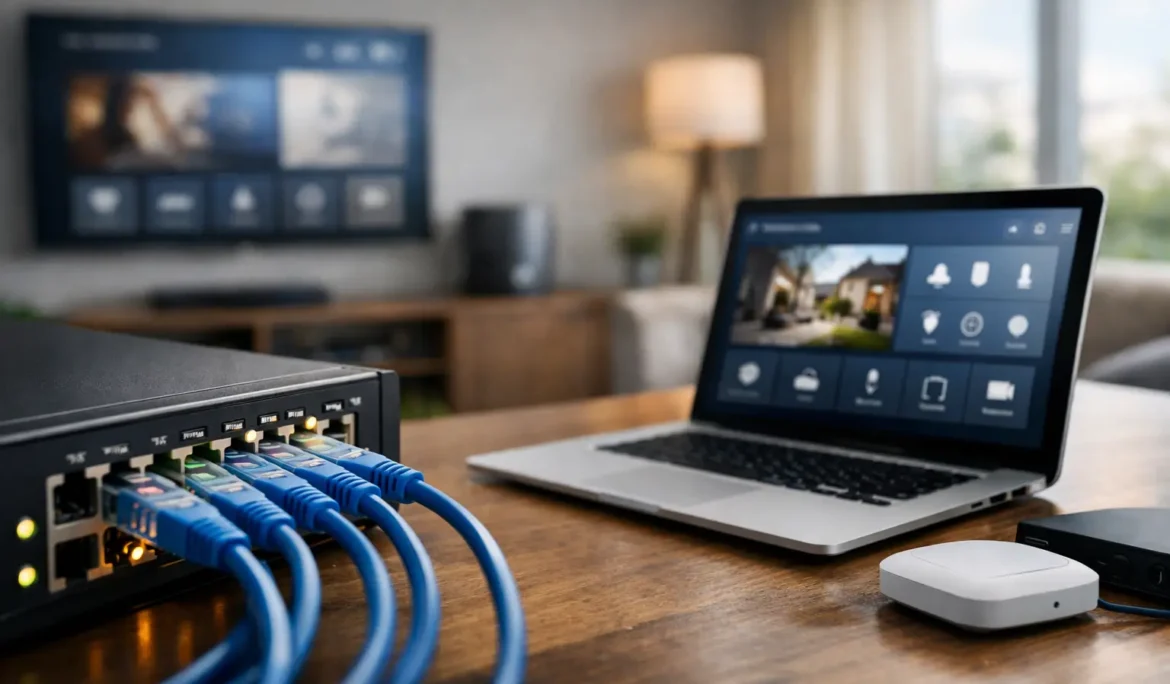
A movie freezes just as the final scene starts. A video call drops when someone begins an online game upstairs. Smart devices respond slowly because the Wi-Fi is busy. These are the everyday frustrations that make wired home network benefits worth considering. For homes with serious entertainment systems, automation, security devices, and multiple users, a professionally planned wired foundation can make technology feel far easier to live with.
Wi-Fi remains essential for phones, tablets, and other mobile devices. But a wireless-only setup asks one network to carry every connection through walls, floors, appliances, and competing signals. A wired network gives the most important equipment a direct, dependable path back to the home’s central network equipment.
Why Wired Home Network Benefits Matter
A wired home network uses Ethernet cabling to connect fixed devices such as televisions, streaming players, gaming systems, wireless access points, security cameras, smart home controllers, and desktop computers. Rather than relying entirely on a radio signal, these devices communicate through physical cable runs installed behind walls, in ceilings, or through structured wiring pathways.
The result is consistency. Wired connections are not affected by a neighbor’s Wi-Fi network, a microwave in use, or the distance between a device and a router. That reliability matters most when a delay, interruption, or failed command becomes noticeable – or frustrating.
For a homeowner, the value is not in seeing cables or managing network settings. It is in pressing play and having the theater respond, joining a call without worrying about the rest of the household’s internet activity, and trusting that the systems built into the home will work as intended.
Better Performance Where It Counts
High-bandwidth entertainment stays dependable
Modern home entertainment can place substantial demands on a network. Multiple TVs may be streaming high-resolution content at once, while a media server sends a movie to a dedicated theater and family members play online games or participate in video meetings.
A wired connection provides stable bandwidth to stationary entertainment equipment. This is particularly valuable for a home theater, a distributed audio/video system, or a premium movie platform where picture quality and fast response are part of the experience. It also reduces the chance that a busy wireless network will affect the performance of the equipment people use most.
Wired networking does not automatically improve the quality of an internet service plan. If the incoming internet connection is the limitation, cabling cannot create speed that is not available. What it can do is prevent unnecessary in-home bottlenecks and help ensure available bandwidth reaches the systems that need it.
Wi-Fi gets stronger, too
One of the most overlooked wired home network benefits is better wireless coverage. Quality Wi-Fi is rarely about placing one powerful router in a basement, closet, or corner office. It is about placing properly designed wireless access points in the right areas of the home, then connecting those access points back to the network with cable.
This approach gives each access point a reliable backhaul connection rather than asking access points to relay traffic wirelessly from one to another. The difference can be significant in larger homes, homes with dense construction materials, and properties with outdoor living spaces.
A well-designed system lets mobile devices move naturally from room to room while fixed components stay on wired connections. It is not a choice between wired and wireless. The strongest home networks use each where it makes the most sense.
Smart home systems respond more reliably
Lighting control, motorized shades, climate controls, voice assistants, doorbells, cameras, and smart home processors all depend on the network. When those devices are installed as separate products over time, the result can be a collection of apps and occasional reliability issues.
A wired infrastructure gives critical smart home equipment a more stable communication path. The central controller, network switches, security camera recorder, and key access points can remain connected even when wireless traffic is heavy. That helps automation commands feel immediate and reduces the troubleshooting that comes with a crowded wireless environment.
Not every smart device needs an Ethernet connection. Battery-powered sensors and many accessories are designed for wireless use. The practical goal is to wire the devices that carry the greatest workload or support the systems your household relies on every day.
A Cleaner Foundation for Security and Work
Security cameras are a strong example of where cabling brings practical advantages. Wired cameras can receive both data and power through a single Ethernet cable using Power over Ethernet, commonly called PoE. This can eliminate the need for a nearby outlet and avoids depending on a wireless signal at the camera location.
For a home office, Ethernet can also make video conferences, large file transfers, and cloud backups more predictable. Professionals working from home do not always need a cable at every desk, but a planned network can provide one where it is useful now and leave options for future needs.
A wired network also makes it easier to organize and support the technology behind the walls. When cabling terminates in a properly planned equipment location, network components can be labeled, protected, and serviced without searching through closets or disconnecting consumer-grade gear scattered around the house.
Planning for the Home You Will Have Later
Network cabling is easiest to install during new construction or renovation, before drywall and finishes are complete. That is the ideal time to consider television locations, theater equipment, offices, access points, cameras, doorbells, outdoor entertainment areas, and places where future technology may be added.
Even in a finished home, strategic wiring can often be added with minimal disruption. The right scope depends on the construction of the property, equipment locations, and how the family uses the space. A media room may need several wired connections, while a guest bedroom may only need excellent Wi-Fi coverage.
Planning also protects the home’s appearance. Equipment can be located where it is accessible without becoming a visual distraction. Access points can be positioned for performance while fitting discreetly into ceilings. Television areas can be designed so cables, streaming equipment, and control components do not compromise the room’s design.
The Trade-Offs to Consider
A wired network requires thoughtful design and professional installation. Cabling routes, equipment placement, ventilation, electrical considerations, and future expansion should all be addressed early. It is more involved than buying a mesh Wi-Fi kit, especially in an existing home.
It also is not necessary to wire every device. Phones, tablets, laptops, and many low-bandwidth smart devices benefit from well-designed Wi-Fi. The point is to avoid putting high-demand, fixed equipment on wireless connections simply because the network was never planned to support them.
For some smaller homes with modest internet use, upgraded Wi-Fi alone may be sufficient. For a larger residence, a dedicated theater, whole-home audio, multiple streaming zones, extensive automation, or security cameras, the wired foundation becomes increasingly valuable. The more connected the lifestyle, the more the network deserves to be treated as a core home system rather than an afterthought.
What a Professional Network Design Changes
A professional network design begins with the household, not a list of products. How many people are online at once? Which rooms are used for entertainment and work? Are there plans for a theater, outdoor TV, motorized shades, cameras, or whole-house control? What areas need dependable coverage?
From there, a technology specialist can identify where wired connections provide the greatest return, where wireless access points should be installed, and how to keep the entire system straightforward to use. Cine Acoustic approaches network planning as part of the larger technology experience, so entertainment, automation, and connectivity are designed to work together instead of being installed as separate projects.
The best network is rarely the one with the longest specification sheet. It is the one that supports the way your household actually lives, remains organized as technology changes, and stays out of the way when you simply want to enjoy your home. A wired foundation gives that experience room to grow.