

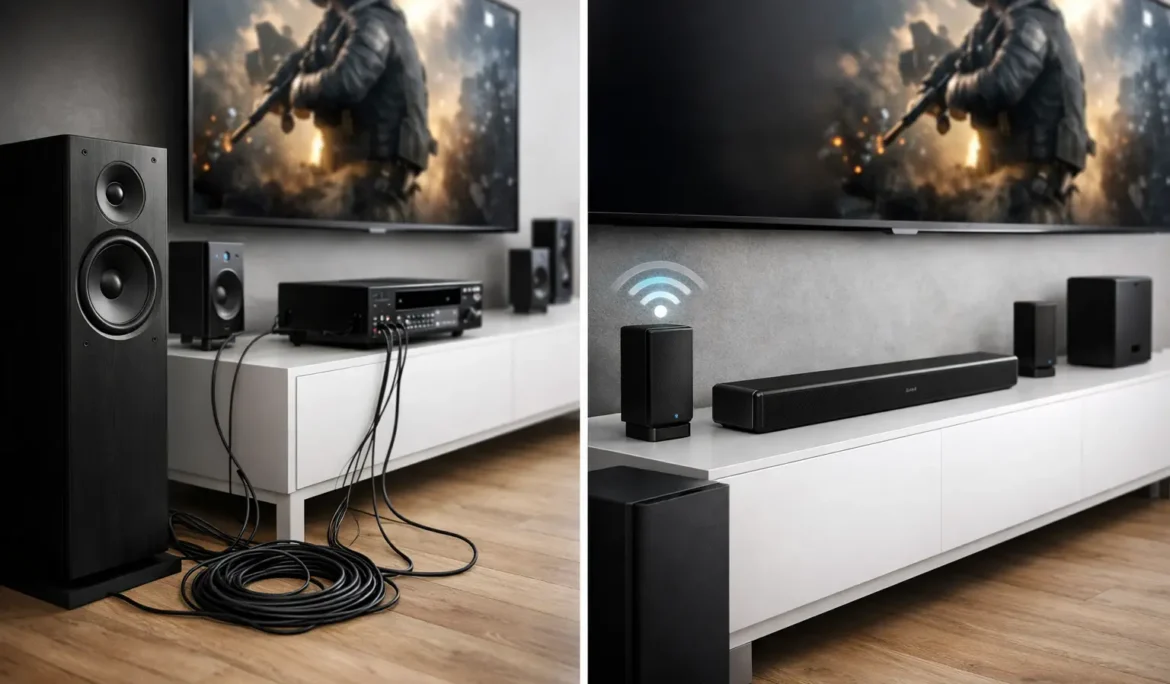
A beautiful media room can lose its appeal fast when the sound cuts out during a key scene or the rear speakers never quite feel in sync. That is why wired vs wireless surround sound is not just a technical debate. It is a practical decision that affects performance, reliability, room design, and how easy your system is to live with every day.
For many homeowners, the choice sounds simple at first. Wired feels traditional. Wireless sounds more convenient. But once you look at how these systems behave in real rooms, with real walls, furniture, Wi-Fi traffic, and daily use, the answer becomes more nuanced. The best option depends on what you want the room to do and how much you value clean aesthetics, consistent performance, and long-term ease of use.
Wired vs wireless surround sound: what changes in real use?
At a basic level, both approaches aim to create immersive audio around the listener. The difference is how the speakers receive signal and, in some cases, power.
A wired surround sound system uses speaker wire to connect each speaker back to an AV receiver or amplifier. This is the classic home theater format, and it remains the benchmark for fully integrated rooms because the signal path is direct and predictable.
A wireless surround sound system reduces or eliminates speaker wire runs for some channels, most often the rear speakers or subwoofer. That sounds cleaner on paper, but wireless does not always mean wire-free. Many wireless speakers still need power at their location, so instead of running speaker cable through walls, you may still need a nearby outlet or a visible power cord.
That detail matters. Homeowners are often less concerned with the type of signal transport than they are with what the room looks like after installation. A system marketed as wireless may still leave cords in places you did not expect.
Sound quality and reliability
If your top priority is the best possible home theater performance, wired systems still hold the advantage. They offer a stable connection, low latency, and fewer opportunities for interference. In a dedicated theater or a media room where you want precise surround effects, that consistency matters. Dialogue stays locked to the screen, effects move cleanly across the room, and the system behaves the same way every time you use it.
Wireless surround sound has improved significantly, especially with premium brands and well-designed ecosystems. For casual viewing, family rooms, and spaces where running wire is difficult, it can sound very good. But wireless performance depends on more variables. Network congestion, nearby devices, wall construction, and product compatibility can all affect the experience.
That does not mean wireless is unreliable by default. It means the margin for error is smaller. In homes with heavy Wi-Fi use, multiple connected devices, or challenging construction materials, wireless audio can require more careful planning to perform consistently.
For homeowners who want a theater experience that simply works every time, wired remains the safer choice.
Installation and room design
This is where wireless often gets attention. It can simplify installation in finished spaces where opening walls is not desirable. If a room was not prewired during construction or renovation, wireless rear speakers may offer a practical path to surround sound without significant disruption.
That said, the cleanest-looking rooms are not always the ones with wireless products. A professionally planned wired system can hide speaker cabling inside walls, ceilings, millwork, or flooring transitions. The result is often more elegant than a wireless setup with visible power cords and plug-in components.
In new construction or major renovations, wired is usually the better design decision because infrastructure can be built in from the start. In an existing room where preserving finishes is the priority, wireless may be the more efficient route.
The right answer often comes down to timing. If the walls are open, take advantage of that opportunity. If the room is already finished and you want to minimize disruption, wireless deserves a closer look.
Flexibility, upgrades, and long-term ownership
One of the biggest strengths of a wired surround system is flexibility. It gives you more freedom to select speakers, receivers, processors, and subwoofers from different manufacturers. That matters if you want to build a system around performance goals rather than staying inside a single brand ecosystem.
Wired systems also tend to age well. Speaker wire infrastructure is simple and durable, and it supports future equipment changes more easily. You may upgrade speakers, electronics, or room calibration over time without replacing the underlying wiring plan.
Wireless systems can be more dependent on brand-specific platforms, apps, and firmware support. That can be convenient when everything works inside one ecosystem, but it may also limit your choices later. If a manufacturer changes product lines or support policies, expanding or replacing parts of the system may become less straightforward.
For homeowners thinking beyond the first install, this is an important part of the decision. Surround sound is not just about what works on day one. It is about what remains easy to use and serviceable over the years.
Wired vs wireless surround sound for different rooms
The room itself should drive the recommendation more than trends or marketing terms.
In a dedicated home theater, wired is typically the best fit. These spaces are built around performance, immersion, and clean integration. A wired layout supports advanced speaker configurations, strong receiver options, and the kind of consistency people expect when they are investing in a true cinema experience at home.
In a family room or multipurpose living area, wireless may make more sense if flexibility and minimal disruption are priorities. Some homeowners want better surround sound for movies and sports, but they do not want construction work or visible equipment taking over the room. In that case, a thoughtfully selected wireless or hybrid system can be a strong solution.
Bedrooms, bonus rooms, and secondary media spaces are also good candidates for wireless, particularly when the goal is convenience over absolute performance. Not every room needs reference-level theater audio. Sometimes the best system is the one that fits the space naturally and gets used often.
The hybrid option many homeowners prefer
In practice, the decision is not always fully wired or fully wireless. Many of the best systems are hybrid designs.
For example, a room might use a wired front soundstage and receiver for the most critical audio channels, while adding a wireless subwoofer or wireless surrounds where running cable is difficult. This approach can balance performance with practical installation realities.
Hybrid systems are especially useful in finished homes where some wiring paths are accessible and others are not. They let you preserve sound quality where it matters most while reducing disruption in harder-to-reach areas.
This is also where professional system design makes a major difference. A good recommendation is not based on what is easiest to sell. It is based on how the room is built, how the family uses it, and what level of performance and simplicity the homeowner expects.
Ease of use matters as much as technology
The best surround sound system is not the one with the most impressive spec sheet. It is the one your household uses comfortably every day.
A wired system with well-integrated control can feel very simple. Press one button, the display powers on, the correct source appears, and the sound is exactly where it should be. A wireless system can also be easy to use, but only when the network, app behavior, and device pairing are all dependable.
For many homeowners, convenience is not about eliminating wires at all costs. It is about eliminating friction. If a system is attractive, reliable, and intuitive, it will feel more valuable over time than one that looked simpler during shopping but creates small frustrations in daily use.
That is why the planning stage matters. At Cine Acoustic, system recommendations are typically guided by lifestyle first, then technology. That approach helps homeowners avoid buying around a buzzword and instead choose a surround solution that fits the room and the way they actually live.
Which one should you choose?
If you want the strongest performance, the highest reliability, and the most room to grow, wired surround sound is usually the better investment. If you need more flexibility in a finished room and want to reduce construction impact, wireless can be a smart alternative, especially when the system is selected and configured carefully.
There is no universal winner in wired vs wireless surround sound. There is only the better fit for your home, your room layout, and your expectations. The most successful projects start with that reality instead of forcing one approach everywhere.
A great surround sound system should disappear into the experience. You should notice the movie, the game, the concert, and the feeling of being in the middle of it all – not the technology working in the background.