

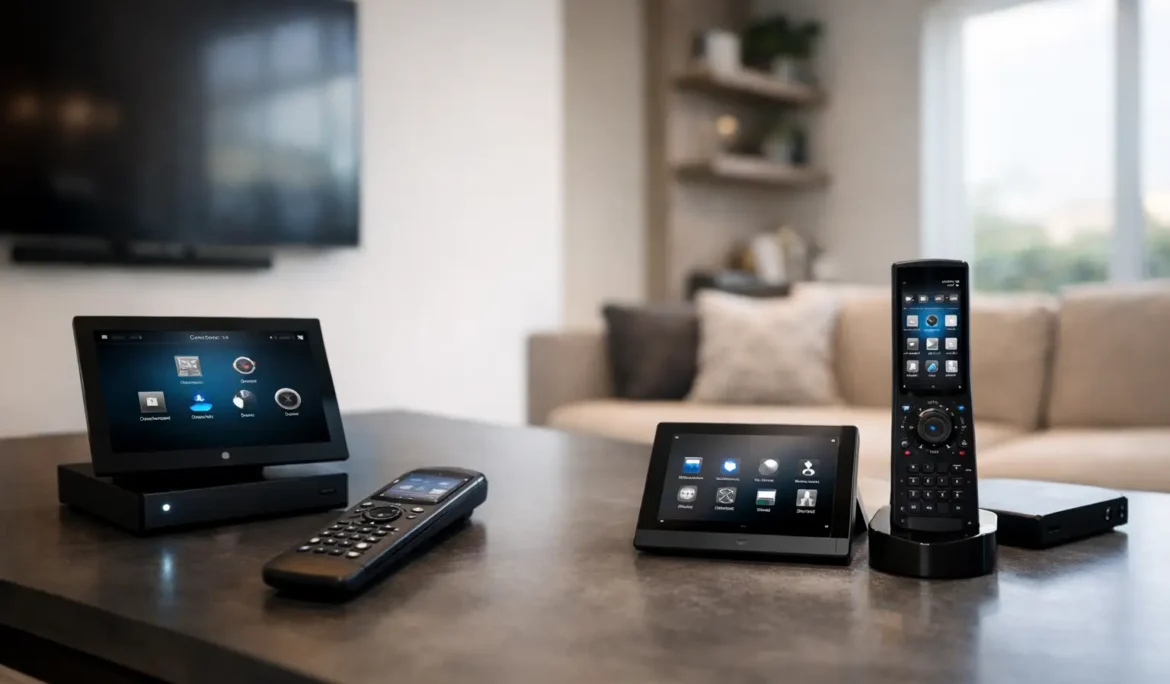
A great theater room should not require a stack of remotes, a phone full of apps, and a troubleshooting session before movie night. When homeowners compare Control4 vs URC systems, the real question is usually simpler: Which platform will make entertainment and everyday living easier for my household?
Both Control4 and URC are respected control platforms used in professionally designed smart homes. Both can bring TVs, projectors, audio systems, lighting, shades, climate, and other connected devices into an organized experience. Their strengths are different, however. The right choice depends on how much automation you want, how your family uses technology, and how your home may evolve over time.
Control4 vs URC Systems: The Core Difference
Control4 is built as a broad home automation platform. It is designed to bring many systems throughout a residence into one coordinated interface, from the theater and whole-house audio to lighting scenes, motorized shades, door locks, cameras, and climate control. Its central advantage is the ability to create connected experiences across rooms and devices.
URC is especially well known for powerful, refined control of entertainment systems. It can also support smart home control, including lighting, shades, climate, and security-compatible devices, but it is often the natural fit when the priority is dependable, intuitive command of a media room or AV-focused home. A well-programmed URC remote can replace the clutter and confusion of multiple manufacturer remotes with a single familiar controller.
Neither platform is inherently better in every home. Control4 generally makes more sense when whole-home automation is central to the project. URC can be an excellent choice when straightforward entertainment control is the main goal, or when homeowners want smart-home convenience without building their daily routine around extensive automation.
Control4: Built for Connected Living
Control4 gives homeowners one ecosystem for a wide range of technologies. Instead of treating a theater, kitchen audio, lighting, shades, and front-door access as separate systems, it can coordinate them through touchscreens, remotes, keypads, wall controls, and mobile devices.
This matters when automation goes beyond turning devices on and off. A “Good Night” scene might turn off selected lights, lower shades, lock compatible doors, adjust the thermostat, and power down entertainment zones. A “Movie” scene can lower the projector screen, select the correct source, set lighting to a comfortable level, and close the shades. The experience is designed around what you want to do, not around which device has to be controlled first.
Control4 is particularly compelling for new construction and larger renovations, where technology can be considered early alongside lighting plans, millwork, network design, and room use. It also works well for homeowners who expect to add technology over time and want a consistent control experience as the home grows.
URC: Focused, Familiar, and Entertainment-First
URC is often the answer for homeowners who want the family room, media room, or dedicated theater to work flawlessly every time. Its handheld remotes and touch interfaces are designed to put common commands within easy reach: watch cable, start a streaming device, adjust volume, select a music source, or control theater lighting.
That simplicity should not be mistaken for limited capability. A professionally configured URC system can manage sophisticated AV equipment and coordinate compatible smart-home devices. The difference is in the emphasis. URC often feels more like a highly capable universal remote platform that can expand into home control, while Control4 is more commonly approached as a home automation ecosystem with entertainment at its center.
For a household with guests, children, or family members who prefer physical buttons over a touchscreen, URC can be especially appealing. A dedicated remote with clearly labeled activities reduces the friction of using a premium entertainment system.
How Each System Feels in Daily Use
The day-to-day experience is where the decision becomes personal. Control4 offers multiple ways to interact with the home. A homeowner may start music from a keypad, use a touchscreen to view cameras, launch a scene from a phone, or press a custom button on a remote. This flexibility is valuable in a whole-home environment, although it benefits from thoughtful system design so the interface stays clear and consistent.
URC centers the experience around direct control. In a theater, that can be exactly what people want. Press one button for a favorite activity, and the system handles the appropriate source selection and device commands in the background. The interface can also provide access to lights, shades, and other supported controls without making the room feel overly technical.
The best system is not the one with the longest feature list. It is the one your household will use comfortably without needing instructions. A homeowner who wants customized scenes and coordinated controls throughout the residence may appreciate Control4’s depth. Someone who primarily wants an elegant, dependable way to operate an advanced entertainment system may prefer URC’s focused approach.
When Control4 Is Often the Better Fit
Control4 is commonly the stronger choice when several areas of the home need to work together. It is well suited to residences with distributed audio, multiple video zones, lighting control, shades, cameras, climate integration, and dedicated entertainment spaces.
It also serves homeowners who value consistency. The same design logic can follow you from the kitchen to the patio to the theater: familiar icons, familiar scene names, and control options that make sense in each room. For design-conscious homes, discreet keypads and clean touch interfaces can reduce visible wall clutter while preserving access to the features you use most.
A connected platform also depends on a strong network foundation. When video streaming, music distribution, cameras, control processors, and wireless devices share the same home network, the underlying design has a direct impact on reliability. This is one reason professional planning matters as much as the brand selected.
When URC Is Often the Better Fit
URC is frequently ideal for a single high-performance entertainment room, a theater upgrade, or a home where AV control is the top priority. It is a strong option for homeowners who want one polished remote to manage a television or projector, surround sound, streaming sources, cable or satellite equipment, and selected room controls.
It can also suit clients who prefer a familiar physical remote experience. Touchscreens are useful, but they are not always the fastest way to pause a movie, skip a track, or make a quick volume adjustment. With URC, those everyday commands can remain immediate and tactile.
URC may also be the right platform when the smart-home scope is intentionally selective. If your goal is to simplify a media room and add convenient control of lighting or shades in that space, a focused solution can feel more natural than a larger whole-home ecosystem.
The Installation and Programming Matter More Than Most People Expect
Control platforms do not deliver their best experience out of the box. Their value comes from the way they are designed, integrated, programmed, and supported for the people living in the home.
A quality installation starts with how your household actually uses each room. Does the family room need simple access for everyone? Should the theater automatically prepare for a film? Do you want entertaining areas to share music while bedrooms remain independent? Are shades part of privacy, glare control, and ambiance? The answers shape the system far more than a generic equipment list.
Programming should also account for the moments when technology needs attention. Clear source names, logical button layouts, sensible room grouping, and dependable network performance prevent small frustrations from becoming daily annoyances. Ongoing support matters as equipment changes, streaming services update, and household routines evolve.
Choosing Between Control4 and URC
Start with the experience you want rather than the product name. If you are planning a connected home where lighting, shades, entertainment, comfort, and security-related controls should work together across many rooms, Control4 deserves close consideration. If your main objective is effortless command of a sophisticated theater or media system, with optional room-level smart control, URC may be the more direct path.
There is also room for nuance. A home may need a Control4-based automation plan in shared living areas while prioritizing a certain remote style in the theater. The right recommendation comes from evaluating the home’s layout, the technologies involved, the people using them, and the level of control that feels comfortable.
For New Jersey homeowners planning a renovation, new home, or entertainment upgrade, a consultation with an experienced integration team can turn that decision into a practical design plan. The best result is not more technology on the wall or in a rack. It is a home that responds naturally when it is time to relax, host friends, or simply enjoy a favorite movie without thinking about the equipment behind it.