

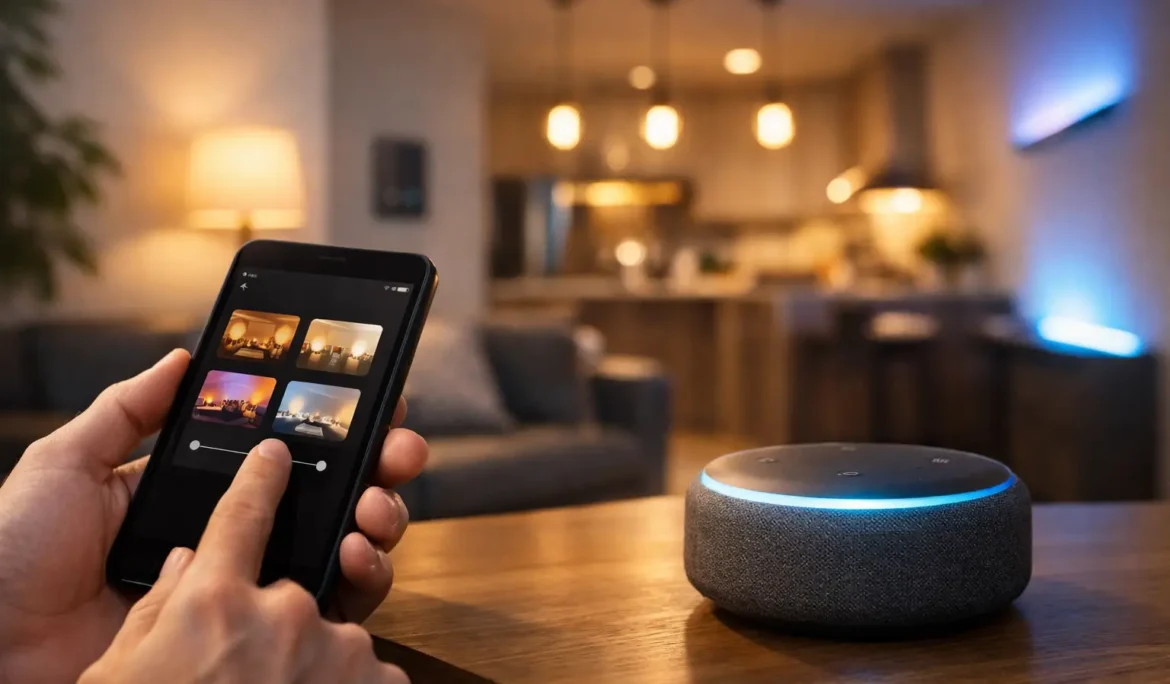
The difference between a room that looks good and a room that feels right often comes down to light. Knowing how to automate lighting scenes lets your home respond to the moment: a bright kitchen for busy mornings, a warm living room for family time, or a theater that dims before the opening scene begins.
Lighting scenes are not about adding more switches or asking everyone to use an app. They are about replacing a collection of small, repetitive decisions with simple, dependable controls that fit your routine. The best systems make the technology nearly invisible while giving every room a more intentional look and feel.
What Is a Lighting Scene?
A lighting scene is a saved combination of light levels, fixture settings, and sometimes shade positions that can be activated with one command. Instead of adjusting recessed lights, lamps, pendants, and accent lighting individually, you press one button labeled “Dinner,” “Relax,” or “Goodnight.”
A scene can be started from a wall keypad, touchscreen, voice assistant, mobile device, or an automated schedule. In a fully integrated smart home, it can also work alongside motorized shades, audio, climate, and home theater equipment.
The goal is not to automate every light for the sake of automation. It is to create useful settings that make daily life easier, more comfortable, and more consistent.
How to Automate Lighting Scenes Around Real Routines
The most successful lighting plans begin with how your household actually uses each space. Start by walking through a typical weekday, then think through weekends, entertaining, travel, and bedtime. You will quickly see which moments deserve a one-touch scene.
For example, a “Morning” scene may raise kitchen and bathroom lighting gradually, bring up hallway lights to a comfortable level, and open shades in primary living areas. A “Welcome Home” scene can light the entry, kitchen, and main pathways after sunset without making the entire house feel fully illuminated.
In a family room, “Relax” may lower overhead fixtures while leaving table lamps and accent lights on. “Cleaning” does the opposite, bringing the space to full brightness when visibility matters more than ambiance. The names should be plain and immediately recognizable. A guest should not have to guess whether “Evening Glow” means reading lights or lights out.
Build scenes by activity, not by room
A room-by-room approach can create too many controls. A better approach is to focus on activities that happen throughout the home. “Goodnight,” for instance, can turn off common-area lights, leave a dim route to bedrooms, lower shades where appropriate, and confirm that exterior lighting is set for the evening.
This approach also makes the system more valuable over time. The scene reflects a behavior, not a floor plan. If you later update a room or add fixtures, the routine can remain just as simple.
Choose the Right Types of Control
A reliable lighting system gives you more than one way to activate a scene. Physical controls remain essential because they are fast, intuitive, and work for everyone in the household. A well-placed keypad near the front door, kitchen, primary suite, or theater room often becomes the preferred way to use daily scenes.
Mobile apps add convenience when you are away from home or already seated. Voice control can be useful for hands-free moments, such as carrying groceries or putting a child to bed. However, it is usually best as a secondary option rather than the only way to operate lighting. Spoken commands can be less convenient in a noisy room, and guests may not know the exact phrasing.
For the most polished result, use each control method where it makes sense. Keypads handle everyday routines. A unified home control interface can coordinate larger experiences. Schedules and sensors take care of predictable background tasks.
Consider dimming, color temperature, and shades
Not all lighting needs the same type of automation. Dimming is the foundation of most scenes because it changes the character of a room immediately. Warm dimming fixtures can make evening scenes feel more relaxed as the light level decreases, while adjustable color temperature can support brighter, cooler light for morning tasks and warmer light after sunset.
Motorized shades can make a lighting scene even more effective. During the day, shades can reduce glare in a media room, protect furnishings from direct sunlight, or preserve privacy. In the evening, they can close as interior lights come on. The right balance depends on the room, window orientation, privacy needs, and architectural style.
Start With Four High-Value Scenes
You do not need dozens of scenes to see a major improvement. Begin with a small set that solves recurring frustrations. These four are useful in many homes:
- Morning: Comfortable task lighting in the kitchen, bathrooms, and hallways, with a gradual transition from nighttime settings.
- Welcome Home: Entry and pathway lighting that activates after dark, creating a safe and inviting arrival.
- Entertain: Layered lighting for dining and gathering areas, with bright task zones reduced and decorative fixtures emphasized.
- Goodnight: Common-area lights off, selected pathways at a low level, and an easy way to secure the home’s evening lighting routine.
A media room or dedicated theater deserves its own scenes. “Movie” can dim house lights, reduce screen glare, close shades, and prepare the room for viewing. “Intermission” can bring lights up enough for guests to move around without interrupting the atmosphere. These details are what make a home theater feel considered rather than merely equipped.
Use Schedules and Sensors Carefully
Schedules are excellent for exterior lighting, seasonal changes, and routines that happen at nearly the same time every day. Landscape and entry lights can follow sunset, for example, rather than a fixed clock time that becomes inaccurate as the seasons change.
Occupancy and vacancy sensors are useful in practical spaces such as closets, laundry rooms, pantries, garages, and secondary bathrooms. They can prevent lights from being left on without requiring anyone to think about it. In main living spaces, automatic shutoff should be used more carefully. A sensor that turns lights off while someone is quietly reading or watching a movie creates frustration, not convenience.
The best automation feels helpful because it respects the people in the room. Use sensors where behavior is predictable, and rely on thoughtfully labeled scene controls where personal preference matters.
Avoid the Common Scene-Planning Mistakes
The most common mistake is creating too many scenes. When a keypad has a long list of vague options, people return to using standard switches. Keep the daily choices limited, clear, and tied to genuine routines.
Another issue is setting every fixture to the same level. Good lighting is layered. Recessed lights provide general illumination, but pendants, lamps, wall sconces, art lights, and toe-kick lighting create depth. A strong scene uses these layers differently rather than making the room uniformly bright or uniformly dim.
It is also wise to plan for manual control. There will always be moments when someone wants to adjust one area without changing the entire room. A quality system should let you refine a scene easily while preserving the simplicity of one-touch operation.
Finally, avoid building automation around products that do not communicate reliably with each other. A collection of disconnected smart bulbs, switches, apps, and voice assistants can become difficult to manage, especially after a network change or software update. Integrated lighting control is designed to provide a more dependable, consistent experience across the home.
Plan Lighting Scenes During a Renovation or New Build
If you are renovating or building, lighting scenes should be considered early, alongside electrical plans, window treatments, furniture layouts, and AV design. This gives you more options for keypad placement, fixture selection, dimming compatibility, shade wiring, and equipment locations.
Interior designers and architects often benefit from this coordination because the lighting plan can support both the visual design and the homeowner’s everyday use. A beautiful fixture is only part of the experience. Its dimming behavior, circuit grouping, and role within a scene determine whether it performs as intended.
For existing homes, scene automation is still very achievable. The right path depends on the current wiring, fixture types, desired level of control, and whether lighting will be integrated with other home systems. A professional assessment helps identify where a focused upgrade will deliver the greatest everyday benefit.
Make the System Easy to Live With
Once scenes are programmed, live with them for a few weeks before treating the setup as final. You may find that the kitchen is too dim for breakfast, the hallway path needs one additional light, or the entertaining scene should be warmer. Fine-tuning is part of creating a system that feels personal.
Cine Acoustic helps homeowners create lighting control that supports the way they live, with intuitive interfaces and thoughtful coordination across the home. The result should never feel like more technology to manage. It should feel like your home already knows what a comfortable evening, a productive morning, and a great movie night require.
The best lighting scene is the one you stop noticing because it works exactly when you need it.