

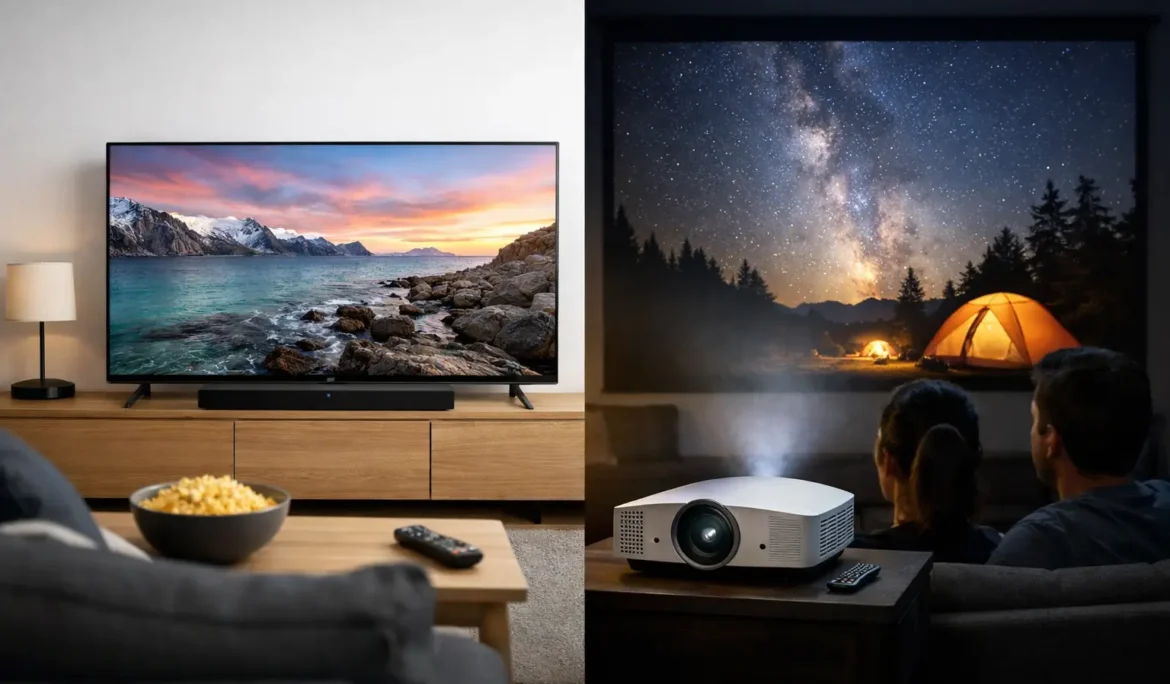
The right display can make a media room feel effortless – or leave you adjusting blinds, moving seats, and second-guessing the setup every time you watch. When homeowners ask about sony tv vs projector, the real question is usually simpler: what will feel better to live with in your home, day after day?
That answer depends less on brand loyalty and more on room conditions, viewing habits, and how polished you want the final experience to feel. A great TV can be the smartest choice in one space, while a projector can transform another. The difference comes down to how the room is used and what kind of experience matters most to you.
Sony TV vs projector: the first decision is your room
If the room has lots of natural light, a TV usually starts with a major advantage. Even an excellent projector can struggle against sunlight or bright ambient light, especially during daytime viewing. A Sony TV is built to maintain contrast, color, and clarity in conditions that would wash out many projected images.
That matters in family rooms, open-concept living areas, and multipurpose spaces where people are not interested in darkening the room just to watch a game or a movie. If the display will be used for casual TV, news, streaming, and sports throughout the day, the convenience of a TV is hard to ignore.
A projector changes the equation when the room can be controlled. In a dedicated media room or home theater, where lighting, seating, and screen placement are planned correctly, the experience becomes more cinematic. You are no longer just watching content. You are creating scale and immersion that a standard TV often cannot match.
Picture quality is not just about resolution
On paper, many displays look similar. In actual use, image quality depends on brightness, black levels, color accuracy, motion handling, and the surface you are viewing on.
A Sony TV typically delivers stronger performance in contrast and HDR impact, especially in bright or mixed lighting. Blacks tend to look deeper, highlights more precise, and fine detail easier to see without needing the room perfectly dialed in. For homeowners who want a premium image with minimal compromise, that reliability is a major reason TVs remain so popular.
Projectors can produce a beautiful image, but they are more dependent on the environment. The projector itself matters, but so does the screen, the wall color, the lighting plan, and the distance from the lens to the screen. When those elements are coordinated, the result can be stunning. When they are not, the image can feel flatter than expected.
This is where professional design makes a noticeable difference. A projector is rarely just a product decision. It is part of a full-room decision.
Why screen size changes the experience
A TV may deliver the sharper, punchier image in many rooms, but a projector wins on scale. Once you move into truly large screen sizes, the emotional impact changes. Movies feel bigger. Sports feel more social. Gaming feels more involving.
That is why people who have a dedicated theater room are often drawn to projection. If you want that front-row cinema feel, image size matters. A large Sony TV can be impressive, but a properly installed projector system creates a different kind of presence in the room.
The trade-off is that bigger is not automatically better. If seating is too close, the room is too bright, or the screen placement is awkward, a giant image can become tiring rather than exciting. The best setup matches screen size to room dimensions and viewing distance.
Everyday usability often favors a TV
Many homeowners begin by thinking about movie night, then realize most viewing is far more routine. Morning news, a quick streaming session, cartoons before school, a playoff game with lights on – these are the moments where ease of use matters.
A Sony TV is usually simpler in day-to-day life. Turn it on, select the source, and the image is immediately bright and consistent. There are fewer variables, less maintenance, and less dependency on room conditions.
Projectors have improved significantly, especially with modern laser models, but they still ask more of the space and often more of the user. You may need to think about light control, screen alignment, and startup behavior in a way that simply does not come up with a TV.
That does not make projectors inconvenient by default. It just means they perform best when the room is designed around them and the control experience is thoughtfully integrated. For homeowners who want one-touch simplicity, that planning is not optional.
Sony TV vs projector for design-conscious homes
This comparison is not only about picture. It is also about how the system fits the room aesthetically.
A TV is visible all the time. In some homes, that is perfectly acceptable. In others, especially carefully designed living spaces, a large black screen can dominate the room more than the homeowner wants. The larger the TV, the more this becomes a design conversation.
A projector can be more discreet when paired with a retractable screen or a room designed to conceal the technology. That flexibility is a major benefit in spaces where entertainment needs to coexist with architecture, furnishings, and a clean visual style.
Of course, the hardware still needs a home. A projector requires proper mounting, cabling, ventilation, and screen integration. If those details are treated as an afterthought, the room can end up looking more complicated instead of more refined.
For design-conscious clients, the best answer is often the one that disappears into the room until it is needed.
Sound should be part of the decision
Display choices often get all the attention, but audio is what makes the room feel complete. A beautiful image with weak sound never feels fully immersive.
A Sony TV may include decent onboard audio, but most premium spaces benefit from a dedicated sound system. Dialogue becomes clearer, bass gains authority, and the room feels more engaging at lower and higher volumes alike.
With a projector, external audio is even more important. The screen size suggests a theatrical experience, and built-in sound rarely keeps up with that expectation. In practice, a projector setup should usually be planned together with surround sound or a properly designed speaker system.
This matters because the best choice is not just the better screen. It is the better overall entertainment experience.
The control experience matters more than people expect
One reason some homeowners hesitate on a projector is that they remember older systems that felt clumsy. Multiple remotes, awkward source switching, and slow startup can make even a high-end room feel frustrating.
That is a design issue, not a projector issue. When the system is integrated properly, using a projector can be as straightforward as pressing one button and letting the room respond automatically. Screen lowers, projector turns on, sources switch correctly, and lighting adjusts to match the activity.
For many families, that ease is what turns a technology investment into something they actually use more often.
When a Sony TV is the better fit
A TV is usually the right answer when the room serves multiple purposes, ambient light is unavoidable, and the system needs to perform beautifully with very little thought. It is also a strong fit for households that watch a mix of casual and premium content throughout the day and want consistent results every time.
If you value crisp picture quality, strong brightness, and simple everyday operation, a Sony TV is hard to beat. In many homes, it is the most practical path to a high-performance entertainment space that feels polished rather than complicated.
When a projector is the better fit
A projector makes the most sense when the goal is immersion and the room can support it. Dedicated theaters, bonus rooms, and carefully planned media spaces are where projection tends to shine. If movie nights are a real priority and you want the kind of scale that changes how content feels, a projector can be the more rewarding choice.
It is especially compelling when the room is designed holistically – display, screen, lighting, audio, control, and seating all working together. That is where projection stops feeling like a compromise and starts feeling intentional.
The best answer is usually not one-size-fits-all
In many homes, this is not an either-or decision across the whole property. A bright family room may deserve a Sony TV, while a lower-level theater or dedicated media space is ideal for a projector. Different rooms support different experiences, and that flexibility often leads to better results than trying to force one solution everywhere.
At Cine Acoustic, that is often where the conversation becomes most helpful. The right recommendation is not about choosing the more impressive product on paper. It is about understanding how you live, how the room functions, and what will still feel right long after installation day.
If you are weighing sony tv vs projector, start with the room, not the specs. The best display is the one that makes entertainment feel easy, immersive, and perfectly at home in your space.