

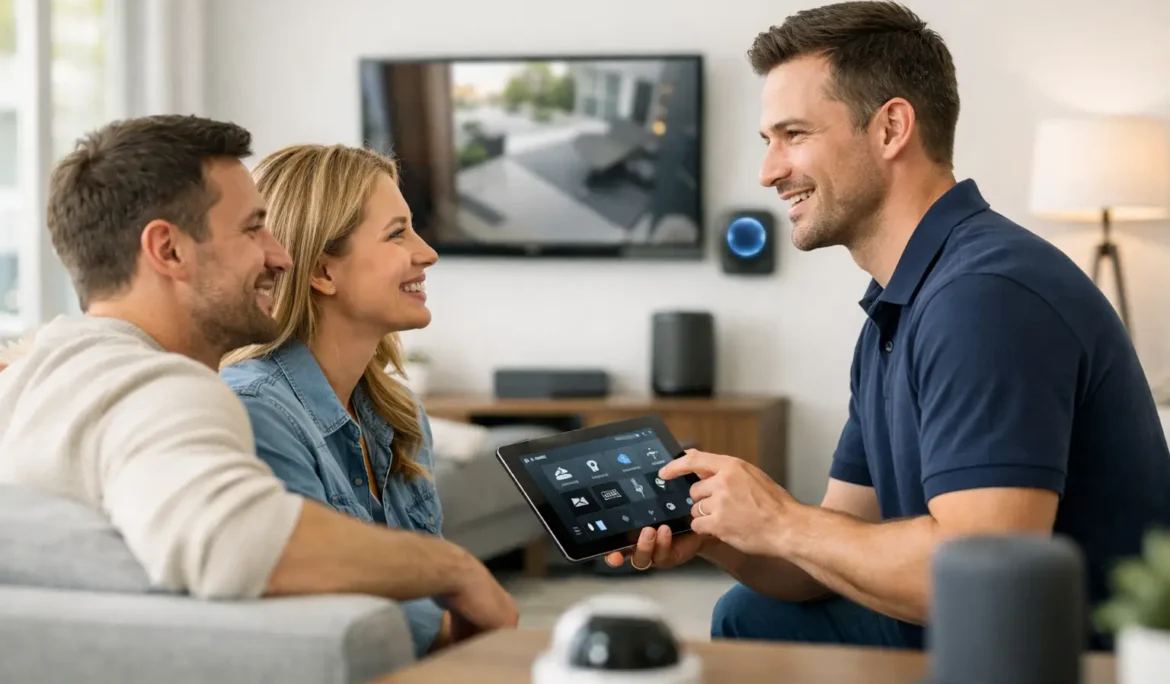
A beautiful new TV, a few smart speakers, and app-controlled lights can feel like a smart home at first. But when the Wi-Fi drops in the backyard, the living room remote controls only half the system, and every family member uses a different app, convenience quickly becomes frustration. So, what does a smart home integrator do? They turn separate products into one dependable, personalized home technology experience.
A smart home integrator plans, installs, programs, and supports the systems that shape how you enjoy your home. That may include home theater, whole-house audio, lighting control, motorized shades, security-compatible automation, Wi-Fi networking, outdoor entertainment, and centralized control. The goal is not to add technology for its own sake. It is to make the technology work naturally around your routines.
What Does a Smart Home Integrator Do?
A smart home integrator is part technology consultant, part system designer, and part installation specialist. Instead of asking a homeowner to choose products one at a time, the integrator begins with the bigger picture: how the home is used, who uses it, which spaces matter most, and what should happen with a single touch or voice command.
For example, a family may want a basement theater that delivers an immersive movie experience without leaving equipment, wires, and remotes in view. They may also want music in the kitchen and patio, lighting that changes for entertaining, shades that help manage afternoon sun, and strong Wi-Fi from the home office to the pool area. These are not isolated purchases. They are connected parts of a single plan.
The integrator coordinates the technology behind that plan so homeowners do not have to become their own IT department, electrician, programmer, and troubleshooter. A professionally integrated system is designed to be powerful behind the scenes and simple in daily use.
It Starts With Listening, Not a Product List
The best smart home projects begin with a conversation. An integrator asks practical questions: Do you entertain often? Are there children, guests, or older family members who need straightforward controls? Is the home being built, renovated, or updated room by room? Do you prefer wall keypads, a handheld remote, a touch panel, or a combination?
This discovery process matters because the right solution depends on the home and the homeowner. A dedicated cinema has different needs than a multipurpose family room. A historic New Jersey home may present different wiring challenges than a new construction project. A design-conscious client may prioritize hidden speakers, discreet wall controls, and TV placement that protects the room’s aesthetic.
An integrator also considers what should be automated and what should remain manual. Not every task needs an automated rule. The most useful systems reduce repeated steps without making the home feel complicated or unpredictable.
Designing the System Around Daily Life
Once the goals are clear, the integrator develops a system design. This includes selecting compatible equipment, mapping where devices will be installed, planning cable routes, identifying network requirements, and determining how the homeowner will control each space.
For a home theater, the design may address screen size, projector or display placement, speaker locations, Dolby Atmos performance, seating layout, acoustic considerations, and equipment ventilation. For whole-house entertainment, it may include distributed audio, shared video sources, outdoor TVs, and a simple way to choose music or television in each zone.
Lighting and shade design follows a similar process. Rather than filling a wall with switches, a well-planned system can use elegant keypads and customized scenes. A “Good Morning” setting might raise selected shades, bring on kitchen lighting, and start a favorite news channel. A “Movie” setting might lower shades, dim lights, and prepare the theater without requiring several remotes.
The important work is often invisible. The integrator makes sure the components can communicate reliably and that the home network can support the demands placed on it.
Building the Network That Holds It Together
Many smart home problems are actually network problems. Streaming video, wireless speakers, smart lighting, cameras, mobile devices, and work-from-home equipment all compete for dependable coverage. A consumer router may be fine for a modest setup, but it can struggle in a larger home, a home with dense construction materials, or a household with many connected devices.
A smart home integrator designs Wi-Fi and wired networking as a foundation, not an afterthought. They evaluate coverage needs, place access points strategically, organize network equipment, and provide the infrastructure that lets connected systems perform as intended.
This is especially valuable when technology expands over time. A network designed with room to grow makes it easier to add an outdoor entertainment area, a new television, additional shades, or another automation feature later. It also reduces the temptation to solve coverage gaps with a collection of disconnected extenders.
Installation Is More Than Mounting Equipment
Professional installation includes the visible details homeowners notice immediately and the technical details they should never have to think about. Equipment is mounted securely, speakers are positioned for performance, wiring is concealed where possible, racks are organized, and components are labeled for efficient future service.
During construction or renovation, the integrator can work alongside the builder, electrician, architect, and interior designer. Early coordination protects both the technology plan and the design vision. It is far easier to plan speaker locations, prewire for future equipment, or provide power for motorized shades before walls are closed.
In an existing home, installation requires a different kind of expertise. The team must find practical paths for wiring, protect finished surfaces, and recommend solutions that improve the experience without turning the project into an unnecessary disruption.
There are trade-offs. Wireless solutions can be appropriate in certain rooms or retrofit situations, while hardwired connections are often preferred for fixed equipment that needs maximum consistency. An experienced integrator explains those choices clearly instead of treating one approach as right for every home.
Programming Makes the Technology Feel Simple
A collection of premium products does not automatically create a good user experience. Programming is what gives the system its logic.
An integrator configures how the devices respond to commands, creates room-specific controls, sets up favorite channels or sources, and builds scenes around the homeowner’s routine. The result might be one button labeled “Watch TV” that turns on the display, selects the correct source, adjusts the audio system, and sets the lighting appropriately.
This is also where customization matters most. One household may want a wall keypad that turns off the entire first floor at bedtime. Another may want individual controls in every room and no whole-home commands at all. A well-programmed system reflects the people using it rather than forcing them to learn a generic setup.
Good programming also keeps control options consistent. Whether a homeowner uses a Control4, Savant, URC, or Lutron-based solution, the experience should be clear enough that family and guests can enjoy it without a tutorial.
Training and Ongoing Support Are Part of the Job
The handoff after installation should not be the end of the relationship. A smart home integrator walks the homeowner through the system, demonstrates the controls, answers questions, and makes sure the setup feels comfortable before the project is complete.
Ongoing support is equally valuable. Technology changes, families move through different routines, and new equipment may be added. A local integration team can help refine settings, diagnose an issue, update a control interface, or expand the system without requiring the homeowner to start over.
This long-term perspective is one reason homeowners choose a full-service partner over piecing together devices from different retailers and installers. When there is one knowledgeable team responsible for the design and operation of the system, service is more straightforward and accountability is clear.
When Is a Smart Home Integrator Worth Considering?
An integrator is especially helpful when several technologies need to work together, when a project involves construction or renovation, or when reliability and clean design matter as much as features. It is also a practical choice for homeowners who want a premium entertainment experience but do not want equipment clutter or a stack of remotes.
For smaller projects, the right starting point may be a single room, a dependable Wi-Fi upgrade, or a lighting and shade solution. The system can then be planned so it grows thoughtfully. The key is having a clear roadmap rather than adding devices that may not work well together later.
The right smart home integrator does not make your home feel more technical. They make the moments you already enjoy – movie night, a relaxed evening on the patio, hosting friends, or getting out the door in the morning – easier to control and better to experience.