

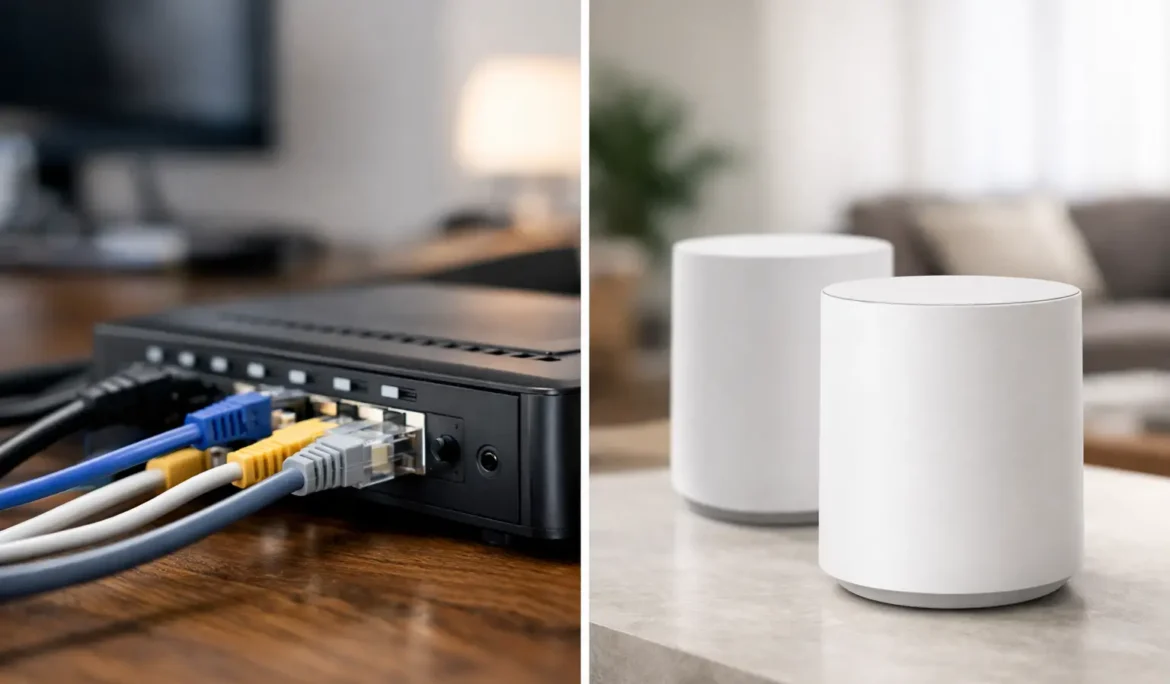
The movie starts buffering right when the lights dim, the kids are gaming upstairs, and a video call freezes in the home office. That is usually the moment homeowners start asking about wired vs mesh home networking. It is a smart question, because the right answer depends less on marketing claims and more on how you actually live in the space.
For some homes, hardwired connections are the gold standard. For others, a properly designed mesh network gives the coverage and convenience a family needs without opening walls. And in many of the best-performing homes, the answer is not either-or. It is a thoughtful combination of both.
Wired vs Mesh Home Networking: What Changes Day to Day?
From a homeowner’s perspective, this is not really a debate about hardware. It is a decision about reliability, speed, appearance, and how much frustration you are willing to tolerate from your network.
A wired network uses Ethernet cabling to connect devices directly back to a central network location. That creates a stable path for data with minimal interference. If you have a home theater, a dedicated media room, a gaming setup, security devices, or work-from-home equipment, wired connections usually deliver the most consistent performance.
A mesh network uses multiple wireless access points or nodes placed throughout the home to extend Wi-Fi coverage. Instead of relying on one router in a bad location, mesh spreads the signal across the property. For larger homes, multi-story layouts, and spaces with dead zones, mesh can make the network feel far more usable.
The key difference is predictability. Wired networking is more dependable because the connection is physical. Mesh is more flexible because the connection is distributed. Neither is automatically better in every home.
When Wired Networking Is the Better Fit
If your priority is performance, wired networking has a clear advantage. Streaming high-bitrate video, online gaming, video conferencing, whole-home AV distribution, and smart home control systems all benefit from stable bandwidth and low latency.
That matters even more in homes with premium entertainment systems. A beautiful display and a high-end audio setup can only perform as well as the network feeding them. If you are using bandwidth-heavy platforms or expecting instant response from connected devices, wiring critical equipment avoids many of the issues that show up on Wi-Fi.
Wired networking also reduces congestion. Every device moved off Wi-Fi leaves more wireless capacity for phones, tablets, and other mobile devices. In practical terms, that can improve the experience everywhere else in the house.
There are trade-offs. Wiring is easiest during new construction or renovation, when walls and ceilings are already accessible. In a finished home, adding cable may require more planning to preserve the design of the space. It is also not realistic to wire every single device in every room. Most families still need strong Wi-Fi for daily use.
Where Mesh Networking Makes Sense
Mesh networking shines when coverage is the main problem. If your current router works fine in one room and poorly everywhere else, mesh can solve a very real issue without forcing every device onto a wired connection.
This is especially useful in larger homes, homes with multiple floors, and properties built with materials that weaken wireless signals. Stone, plaster, metal, and certain architectural layouts can make a single-router setup frustrating no matter how fast the internet plan looks on paper.
A good mesh design places multiple access points where people actually use devices, not just where the modem happens to sit. That gives homeowners better coverage in bedrooms, kitchens, outdoor living areas, home offices, and media spaces.
Mesh also supports the way most people use technology now. Phones, tablets, laptops, smart thermostats, lighting controls, and motorized shades all rely on wireless connectivity. A well-planned mesh network helps those systems stay responsive across the home.
The downside is that mesh is still wireless at its core. Performance can vary based on node placement, interference, construction materials, and the number of connected devices. Mesh improves coverage, but it does not create the same level of consistency as a direct Ethernet connection.
Wired vs Mesh Home Networking for Smart Homes
In a connected home, network quality affects much more than internet browsing. It touches entertainment, automation, lighting, security, and daily convenience.
That is why wired vs mesh home networking should be looked at through the lens of the systems you plan to use. A smart home platform, distributed audio, streaming video sources, and networked control devices all place different demands on the network. Some devices need rock-solid stability. Others simply need strong wireless coverage.
For example, a home theater rack, smart TV, streaming player, gaming console, and media server are ideal candidates for wired connections. Meanwhile, phones, tablets, smart locks, touchscreens, and many automation devices benefit from a strong wireless environment supported by mesh or properly placed wireless access points.
This is where homeowners often run into trouble with off-the-shelf solutions. A package that promises whole-home Wi-Fi may improve signal strength while still leaving gaps in performance for demanding devices. Strong bars on a screen do not always mean a network is ready for premium entertainment and smart home control.
The Best Answer Is Often a Hybrid Network
For many homes, the strongest solution is a hybrid approach. Wire the devices and locations that truly benefit from maximum reliability, then build strong wireless coverage around them.
That might mean Ethernet to the home office, media room, main televisions, and network backbone, with strategically placed wireless access points handling mobile devices and general household connectivity. In larger or higher-performance homes, this approach often delivers the best balance of speed, coverage, and usability.
A hybrid design also gives the network room to grow. As new devices are added, the system can support them without pushing everything onto one overloaded wireless layer. That matters in homes where technology tends to expand over time.
From a design perspective, this approach is also cleaner. You are not forcing visible compromises in finished rooms, and you are not relying on a one-size-fits-all wireless product to solve every challenge.
What Homeowners Should Consider Before Choosing
The right network starts with the home itself. Square footage matters, but layout matters just as much. A smaller home with dense materials can be harder on Wi-Fi than a larger open-plan house. The number of floors, outdoor areas, and where internet service enters the home all affect the best design.
Next, think about usage. A family that streams in multiple rooms, works from home, uses automation systems, and expects flawless performance during movie nights needs a different network than a household with lighter demands. Future plans matter too. If you are renovating, building a theater, or adding integrated smart home features, the network should be designed to support those goals from the start.
Then there is ease of use. Most homeowners do not want to troubleshoot disconnects, reboot hardware, or guess why one room works better than another. They want technology that simply responds when they use it. That is where professional design becomes valuable. Good networking is not just about buying better equipment. It is about proper placement, configuration, and matching the system to the property.
Why Professional Design Makes a Difference
Home networking is one of those areas where small mistakes create daily frustration. A router placed in the wrong spot, too few access points, too many wireless hops, or poor device segmentation can all lead to inconsistent performance.
Professional planning helps avoid that. Instead of guessing, the network is built around the actual home, the actual devices, and the actual expectations of the homeowner. That means identifying where wired connections will make the biggest impact, where wireless coverage needs reinforcement, and how the entire system should work together.
For homeowners investing in entertainment spaces or integrated smart home technology, that planning becomes even more important. The network is not a side detail. It is the foundation that supports everything else.
At Cine Acoustic, that philosophy shapes how technology is designed for the home: around performance, usability, and long-term reliability, not just a quick equipment swap.
The best network is the one you stop thinking about. Whether that means wired, mesh, or a carefully designed mix of both, the goal is the same – dependable performance in every space where your family lives, works, and relaxes.