

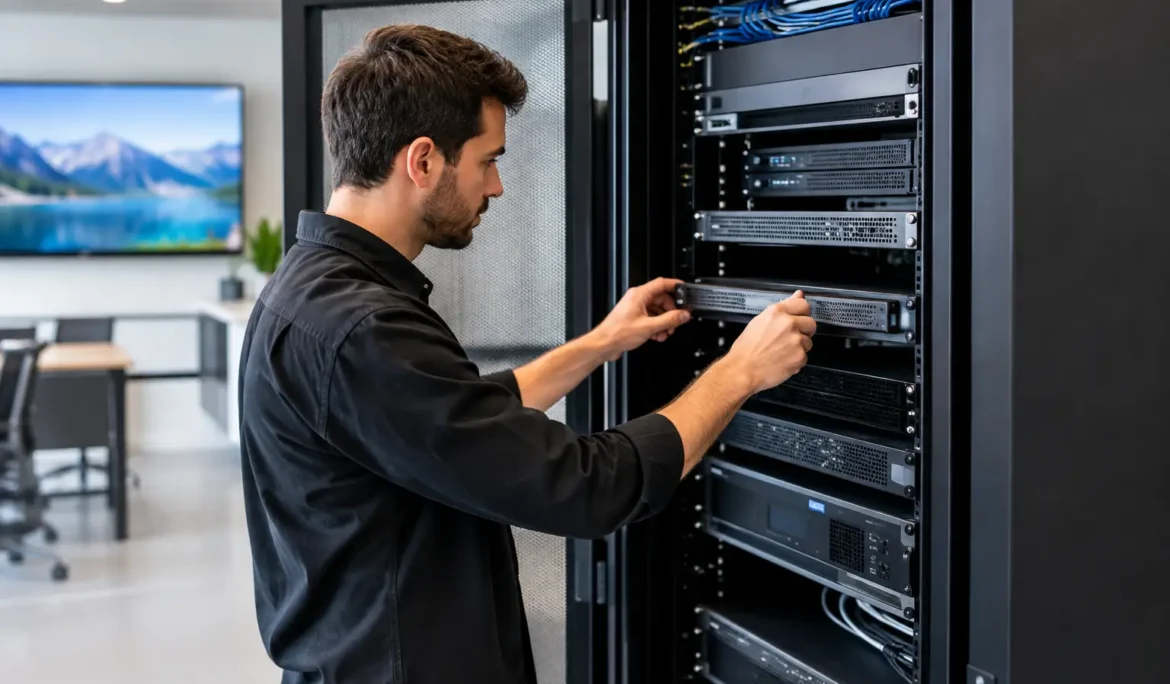
A beautiful theater, a great television, and premium speakers can still feel disappointing when the technology behind them is disorganized. AV rack design is the behind-the-scenes work that gives a home entertainment or smart home system its reliability, order, and day-to-day ease of use. It is where source components, amplifiers, network equipment, control hardware, and power management come together in one planned location.
For homeowners, the goal is not to create a room full of blinking lights. It is to enjoy a movie, music, sports, or whole-home control without wondering why a component is overheating, a network device has lost connection, or a remote command is not responding. A professionally planned rack makes sophisticated technology feel simple at the point of use.
Why AV Rack Design Matters
An AV rack is more than a storage cabinet for equipment. It is a purpose-built system that organizes electronics according to how they perform, connect, cool, and need to be serviced. In a dedicated home theater, the rack may support a surround sound processor, amplifiers, streaming sources, a media server, network switches, and lighting or control components. In a connected home, it can also become the central home for Wi-Fi networking and audio distribution.
Without a plan, equipment often ends up stacked in a cabinet, tucked into a closet, or placed wherever there is an available outlet. That approach may work temporarily, but it creates common frustrations: trapped heat, tangled wiring, difficult troubleshooting, inconsistent connections, and a system that becomes harder to expand after a renovation is complete.
A well-designed rack addresses those issues before installation. It gives every component a defined place, protects sensitive electronics, and lets a technician reach the right connection without dismantling the entire system. Just as importantly, it keeps the living space focused on the experience, not the equipment.
Start With the Experience, Not the Equipment
The best AV rack design begins with how the household wants to use the space. A family room with a television and sound system has different requirements than a dedicated cinema with Dolby Atmos audio, motorized shades, lighting scenes, and a large projection system. A whole-home audio system also requires different planning than a single-room setup.
This is why equipment should not be selected in isolation. The number of zones, display locations, speaker locations, control preferences, network needs, and future plans all affect the rack. For example, a homeowner may initially want television, streaming, and surround sound in one room. If they also expect to add outdoor entertainment, distributed music, or a second media space later, the rack should allow room for that growth.
Planning around lifestyle also keeps control intuitive. The technology may be complex inside the rack, but the homeowner should be able to select a favorite movie, adjust the lights, or start music from a familiar remote, keypad, touchscreen, or app. The rack supports that simplicity by giving the underlying control and network hardware a dependable foundation.
Heat Management Is a Performance Requirement
Heat is one of the most overlooked factors in rack planning. Amplifiers, receivers, video processors, network switches, and media components all generate heat. When they are tightly packed into an enclosed cabinet without airflow, performance can suffer. Components may shut down, operate inconsistently, or have a shorter useful life.
Proper ventilation is not just about leaving a small gap between components. It requires a complete airflow strategy. Equipment that produces more heat may need dedicated spacing, vent panels, thermostatically controlled fans, or a rack location with a clear path for warm air to escape. The rack enclosure itself matters as well. A finished built-in may look clean, but it must be designed to move air effectively.
There is a trade-off to consider. A rack placed in a remote utility area can reduce noise and keep equipment out of sight, but it may require more cable runs and careful planning for service access. A rack near the theater can shorten those runs, but fan noise and visual impact must be managed. The right location depends on the room layout and the homeowner’s priorities.
Leave Space for Service and Future Additions
A tightly filled rack can look efficient on installation day, yet become a problem later. Equipment changes. New sources are introduced. A network upgrade may require another switch or access point connection. Leaving available rack space provides flexibility without requiring a major rebuild.
Service access is equally important. Rear connections should be reachable, and the rack should allow qualified technicians to identify equipment and test connections quickly. In many cases, a pull-out or swing-out rack design makes this practical in a closet or finished millwork installation. The exact solution depends on the available space, but access should never be an afterthought.
Power Protection and Clean Electrical Planning
High-performance technology relies on stable power. A rack should have organized electrical distribution and appropriate protection for the equipment it supports. This helps guard against power events and reduces the temptation to rely on crowded power strips hidden behind components.
Power management also makes service more efficient. Clearly assigned outlets and labeled circuits help identify what is connected where. Certain systems may benefit from controlled power sequencing, particularly when multiple amplifiers or network components need to start up in a deliberate order. That can prevent unnecessary electrical strain and support more consistent operation.
The details matter here. A dedicated electrical approach may be appropriate for a larger theater or equipment-heavy home, while a smaller media setup may have more straightforward needs. The right design is based on the actual system, not a one-size-fits-all equipment list.
Cable Management Makes Reliability Easier to Maintain
The rack’s wiring is where thoughtful design becomes immediately visible to anyone servicing the system. Cables should be routed cleanly, supported properly, and separated where appropriate. Power wiring should not be bundled carelessly with low-voltage signal cables, and connections should have enough slack for service without becoming a tangled mass.
Labeling is equally valuable. A label on both ends of a cable can save significant time when adjustments or diagnostics are needed. It also gives homeowners confidence that their system has been built with long-term care rather than assembled for a quick handoff.
Good cable management is not about making the rack look impressive in a photograph, although a clean rack is certainly reassuring. It is about reducing connection failures, avoiding accidental unplugging, and making future changes less disruptive. When equipment is organized logically, the system is easier to support for years.
Network Hardware Belongs in the Conversation
Many entertainment issues are actually network issues. Streaming interruptions, slow control response, unreliable wireless connections, and devices that disappear from an app can all originate with a poorly planned network. That is why modern AV rack design should account for networking from the start.
Network switches, routers, and related hardware need ventilation, power protection, clear cable labeling, and room for expansion. Wired connections should be prioritized where performance matters most, including stationary displays, media servers, control processors, and access points. Wi-Fi remains essential for mobile devices, but a reliable home network is built on more than a single wireless router placed in a convenient corner.
For New Jersey homeowners renovating or building, this is especially valuable to address before walls are closed. Planning structured wiring and rack placement early provides more options and a cleaner finished result.
AV Rack Design Should Respect the Home
A rack can be highly technical without taking over the home. In many projects, it is installed in a dedicated equipment closet, basement, utility area, or custom cabinet that fits the home’s design. The goal is to keep the technology protected and accessible while preserving the clean appearance of the theater, family room, or entertaining space.
This requires coordination with the room design. Door clearance, ventilation paths, equipment depth, cable entry points, and service access all need to work within the architecture. A decorative cabinet that cannot release heat or open fully for service is not a successful solution, regardless of how polished it looks.
Cine Acoustic approaches rack planning as part of the complete technology design, not as a final place to put leftover components. That integrated perspective helps align entertainment, networking, lighting, control, and future expansion around the way the home will actually be used.
A carefully planned rack may stay out of sight, but its value shows up every time the system responds as expected. The best result is technology that feels dependable, organized, and ready when the home is ready to enjoy it.