

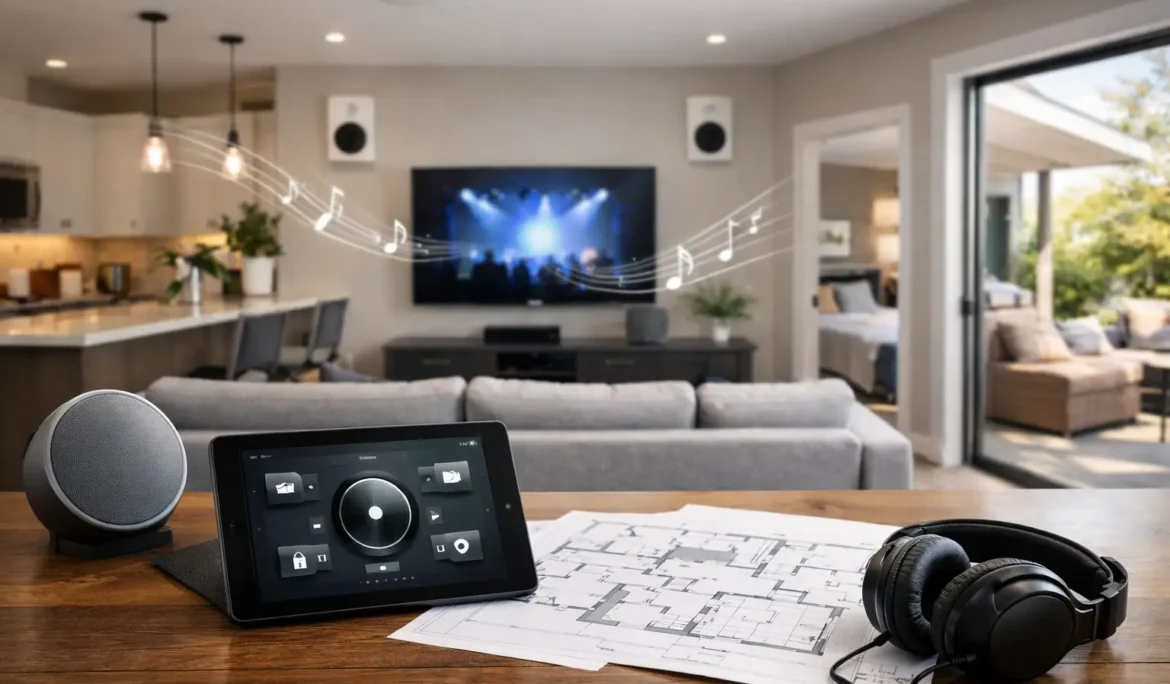
A whole-house audio system should feel less like a collection of speakers and more like a natural part of the way you live. Music can follow a busy morning from the kitchen to the dressing area, set the tone for a dinner party, or bring a favorite playlist outside without anyone hunting for remotes or reconnecting devices. Knowing how to plan whole house audio before walls are opened, finishes are selected, or equipment is purchased helps create that effortless experience.
The best plans begin with your routines, not a speaker catalog. A well-designed system balances sound quality, coverage, control, aesthetics, and the infrastructure that keeps everything dependable for years.
Start With the Rooms That Matter Most
Not every room needs the same audio experience. The kitchen, family room, primary suite, patio, and entertaining areas are often the highest-value zones because they are where people spend time and gather. Secondary spaces such as bathrooms, hallways, laundry rooms, or home offices may benefit from audio too, but the role of music in each space is different.
Think through how each area will be used. In a kitchen, clear background music at normal conversation volume may be the goal. In a media room or great room, you may want a more substantial listening experience that complements the television and creates fuller sound. On a patio, coverage and durability are usually more important than the focused stereo image you might want in a dedicated listening area.
It also helps to picture simultaneous use. Can someone listen to a podcast in the office while the family plays music in the kitchen? Should the kitchen, dining room, and patio play the same playlist during a party? These questions define your audio zones.
A zone is an area with independent control over what is playing and how loud it is. A single open kitchen, breakfast nook, and family room may work beautifully as one zone, or they may need separate controls if the rooms are used independently. More zones create more flexibility, but they also require thoughtful planning so the system remains simple for everyone in the home.
Choose Speakers for the Room, Not Just the Ceiling
Speaker placement has a major effect on how enjoyable the system feels. Ceiling speakers are a popular choice because they preserve clean sightlines and distribute sound evenly through many living spaces. They are an excellent option for kitchens, bedrooms, bathrooms, hallways, and open-concept rooms when selected and positioned correctly.
However, ceiling speakers are not automatically the right answer everywhere. In a formal living room, a media room, or a space where music listening is a priority, in-wall speakers or carefully integrated architectural speakers can provide a more intentional soundstage. A room with very high ceilings may also need a different approach than a room with standard-height ceilings, since sound must travel farther before reaching listeners.
Speaker location should follow furniture and listening areas. For example, placing speakers directly over a kitchen island can work well for casual listening, while a seating area may benefit from a pair positioned to create more balanced left-right sound. Avoid treating speaker placement as an afterthought once lighting fixtures, vents, sprinklers, and beams have already claimed the ceiling.
For outdoor spaces, use purpose-built weather-resistant speakers. A pair mounted under a covered porch may be suitable for a compact seating area, while a larger yard often benefits from multiple landscape speakers placed closer to listeners at lower volume. This approach delivers more even coverage and reduces the chance of sound carrying farther than intended.
Decide What You Want to Play
Most homeowners want easy access to music streaming services, internet radio, personal music libraries, and audio from phones or tablets. The system should let family members choose content without requiring technical steps each time they want to listen.
Consider whether television audio should be available beyond the room where the television is located. Some households enjoy sending the sound from a game, concert, or news broadcast to the kitchen or patio. Others prefer whole-house music only, keeping television audio localized. Neither choice is universally better. The right decision depends on how you entertain and whether shared TV audio would be useful or distracting.
If vinyl, a music server, or other physical sources are part of your listening habits, mention them early in the design process. These sources can be incorporated into a whole-house system, but they should be planned for rather than added as a last-minute request.
Make Control Easy Enough for Everyone
A sophisticated audio system should not require a sophisticated user manual. The most successful systems offer a few intuitive ways to control music: a dedicated app, in-wall keypads, handheld remotes where appropriate, and smart-home touchscreens or interfaces.
The best control method often depends on the room. In a kitchen, an in-wall keypad can be especially convenient when hands are wet or a phone is not nearby. In bedrooms, app control may be more than enough. For a home with integrated lighting, shades, and entertainment, a unified platform such as Control4, Savant, or URC can place audio alongside the controls you already use every day.
Keep the experience consistent. If one area requires a separate app, another requires a remote, and a third only works from a streaming device, the house can quickly feel fragmented. A good design makes it easy to select a room, choose music, adjust volume, group areas together, and stop playback without guessing.
Plan Wiring and Network Infrastructure Early
When possible, wired speaker connections remain the foundation of a dependable whole-house audio system. Wiring can be run from a centralized equipment location to each speaker zone, keeping amplifiers and source components organized, accessible, and out of sight. This is particularly valuable during new construction and major renovations, when walls and ceilings are open.
A retrofit can still support excellent whole-house audio, but the design may need to work around finished surfaces, structural conditions, and available pathways. In some homes, a hybrid design using wired speakers in key areas and carefully selected wireless components in others makes practical sense. The trade-off is that wireless products rely more heavily on network performance and power availability.
Your Wi-Fi network deserves the same attention as the speakers. Streaming audio may not seem demanding on its own, but a modern home can have many devices competing for coverage at once: phones, tablets, televisions, cameras, laptops, automation devices, and audio components. Weak coverage, inconsistent handoffs, and poorly placed access points can turn a good audio system into a frustrating one.
A professional network design considers the size and construction of the home, outdoor coverage needs, and the location of equipment. Hardwired network connections should be used where they add reliability, especially for central audio equipment and major entertainment components.
Coordinate Audio With the Rest of the Home
Whole-house audio works best when it is designed alongside lighting, video, networking, and interior details. A ceiling plan that coordinates speakers with recessed lights, decorative fixtures, HVAC vents, smoke detectors, and motorized shades looks intentional rather than crowded.
This coordination matters even more in design-conscious homes. Speaker grilles can often be color-matched or painted to blend with the surrounding surface, but placement is still the first priority. A perfectly matched grille in an awkward location will not improve the experience.
Automation can also make music more useful without making it complicated. A “morning” scene might bring on gentle music in the kitchen and breakfast area along with the lights. An “entertain” scene can set the desired volume in shared spaces while keeping bedrooms quiet. These features should support real habits, not add controls no one uses.
Leave Room for Change
Homes and routines evolve. A nursery becomes a bedroom, a basement becomes an entertaining space, or a patio is expanded into a more complete outdoor living area. If future audio may be valuable in a space, prewiring during construction or renovation is a smart form of flexibility, even if speakers are installed later.
It is also wise to reserve capacity in the equipment plan. That does not mean overbuilding every system. It means selecting an architecture that can accommodate a future zone or source without requiring the entire installation to be rethought.
A Better Way to Plan Whole House Audio
The right whole-house audio system is not defined by the number of speakers. It is defined by whether it gives each area of your home the right sound, the right level of control, and a dependable experience that feels easy from day one.
Before making final decisions, walk through the home room by room with a technology professional who can account for construction conditions, furnishings, acoustics, network needs, and the way your household actually listens. A thoughtful plan turns everyday moments – cooking, relaxing, hosting, and spending time outside – into occasions worth hearing better.