

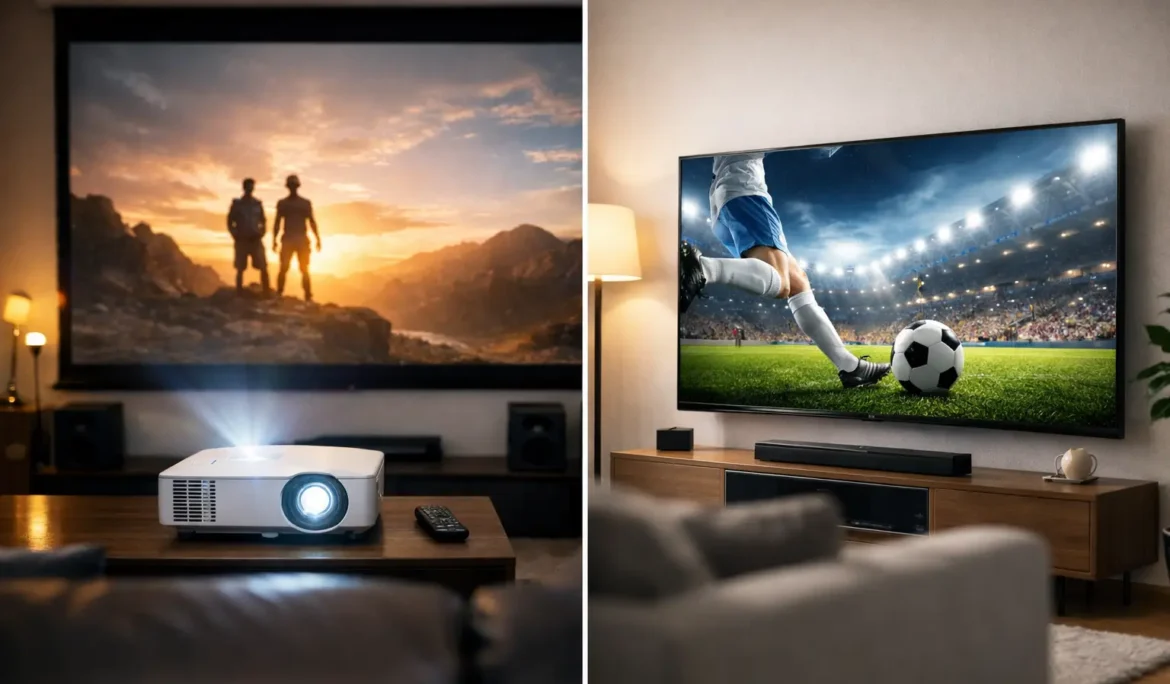
Picture this: movie night starts, the lights dim, and the room either feels like a private cinema or a very polished family room. That difference is usually where the projector vs large screen TV decision becomes more than a spec comparison. It becomes a lifestyle choice.
For some homeowners, a large TV is the right answer because it is bright, simple, and ready for everyday use. For others, a projector creates the scale and immersion a television simply cannot match. The best option depends less on hype and more on how you actually use the room, what you expect from the experience, and how much you want the technology to blend into your home.
Projector vs large screen TV: Start with the room
The room tells the truth quickly. If the space has a lot of windows, frequent daytime use, or bright ambient light, a large screen TV usually performs better. TVs hold contrast and color more consistently in bright conditions, which makes them a dependable choice for family rooms, open-concept spaces, and multipurpose areas.
A projector thrives when the room can be controlled. If you have dedicated media space, blackout shades, thoughtful lighting, and seating positioned around a screen wall, projection starts to make a lot more sense. In the right environment, the image feels larger, softer, and more cinematic in a way that many homeowners are specifically trying to achieve.
This is one of the biggest mistakes people make when comparing displays. They focus on screen size first and room conditions second. In practice, room conditions often matter more.
Why a large screen TV feels easier
A TV is straightforward. Turn it on, and the image looks good with very little effort. There is no need to think about lamp life, projector placement, screen material, or whether the room lighting is working against the image.
That simplicity matters in homes where the display is used constantly. If you watch morning news, afternoon sports, gaming sessions, and late-night streaming in the same room, a large TV fits naturally into that routine. It also tends to integrate more easily into spaces where clean operation and predictable performance matter just as much as image quality.
There is also the matter of perceived sharpness. Many homeowners describe large premium TVs as punchy, crisp, and vivid. That look can be especially appealing for live sports, casual TV watching, and gaming where brightness and responsiveness are front and center.
From a design standpoint, a TV can be a feature or it can be discreet, depending on how the room is planned. Mounted properly with the right surrounding elements, it can feel intentional rather than dominant.
Where projectors create a different kind of experience
A projector is about scale and atmosphere. Even an excellent large TV can start to feel small once you have experienced a well-designed projection system with a true cinema-sized image. The room changes character. You are not just watching content. You are entering it.
That matters most for movie lovers, dedicated sports fans, and homeowners building spaces specifically for entertainment. If the goal is a room that delivers impact, projection is hard to ignore. A larger image changes how action scenes feel, how concerts play, and how immersive the entire system becomes when paired with strong audio.
Projectors also offer an aesthetic advantage in some rooms. When the system is off, a retractable screen or a carefully integrated projection setup can keep the space cleaner and less screen-dominant than a very large TV on the wall. For design-conscious homeowners, that can be a deciding factor.
Still, projection asks more from the room and the system design. Placement, throw distance, screen type, lighting control, and calibration all matter. When those details are handled correctly, the results are excellent. When they are not, disappointment usually follows.
Image quality is not one simple answer
People often ask which has better picture quality, but that question needs context. In a bright room, a premium TV usually looks better. It will appear brighter, more contrast-rich, and easier to enjoy at any time of day.
In a well-controlled room, a projector can deliver an experience that feels more natural and cinematic, especially at larger sizes. That does not always mean it will look brighter or more vivid than a TV. It means the overall viewing experience can feel more like what people associate with a theater.
So the better image is not universal. It depends on whether you value brightness and everyday consistency or scale and immersion.
What matters more than specs on paper
This is where professional guidance makes a difference. Two displays can look impressive in a showroom and perform very differently once placed in a real home. Ceiling height, wall colors, seating distance, window placement, and even how the room is used on weekends versus weekdays all affect the right recommendation.
A homeowner who mainly streams shows with the lights on has different needs than someone building a media room around movie nights and big-game viewing. The product category alone does not give the answer. The use case does.
Everyday living vs dedicated entertainment
If this is your main household display, the large TV often has the edge. It starts fast, handles bright rooms better, and feels less conditional. Everyone in the home can use it without thinking about environment or setup. That ease is valuable.
If the room is meant to be a destination, the projector starts gaining ground. A dedicated entertainment space benefits from the ritual and scale of projection. It turns watching into an event, which is exactly what many homeowners want when they invest in a more intentional media room or theater.
There is no conflict in saying both are excellent. They are simply excellent in different ways.
Projector vs large screen TV for design-conscious homes
In higher-end homes, the decision is often as much about aesthetics and room flow as it is about picture quality. A large TV is visible all the time unless you build around it creatively. In some rooms that is perfectly fine. In others, especially formal living areas or carefully designed great rooms, homeowners prefer technology that recedes when not in use.
That is where projection can be very attractive. A screen can disappear, and the room can maintain a more refined look. On the other hand, some homeowners prefer the modern statement of a beautifully mounted large display. Neither approach is inherently better. It depends on whether you want the entertainment system to lead the room visually or stay in the background.
This is also why integrated design matters. The best outcomes happen when display selection is considered alongside lighting, shades, audio, control, and furniture layout, not after the room is already finished.
Sound should be part of the conversation
Display decisions get most of the attention, but the experience is never just about the screen. A huge image paired with weak sound feels incomplete. Likewise, a bright impressive TV still benefits dramatically from a properly designed audio system.
Projectors often live in spaces where homeowners are already aiming for a more cinematic result, so audio tends to become part of the plan. That combination can be transformative. A large TV in a family room can also be exceptional when the sound is designed to match the space and stay easy to use.
The key is to think in systems, not isolated products. The best media spaces work because every element supports the way the room is meant to function.
So which one is right for you?
Choose a large screen TV if you want strong performance in bright conditions, easy daily use, and a display that works well in multipurpose living spaces. It is often the better fit for homes where convenience and consistent performance are the top priorities.
Choose a projector if you want the biggest possible image, a more cinematic feel, and a room designed around entertainment rather than general living. It is often the better fit when immersion matters more than all-day flexibility.
If you are torn, that is usually a sign the room needs a more thoughtful evaluation rather than a quicker purchase decision. At Cine Acoustic, this is exactly the kind of choice that benefits from a consultative approach, because the right answer should fit your home, your habits, and your expectations for years to come.
The best screen is the one that makes the room feel right every time you use it.