

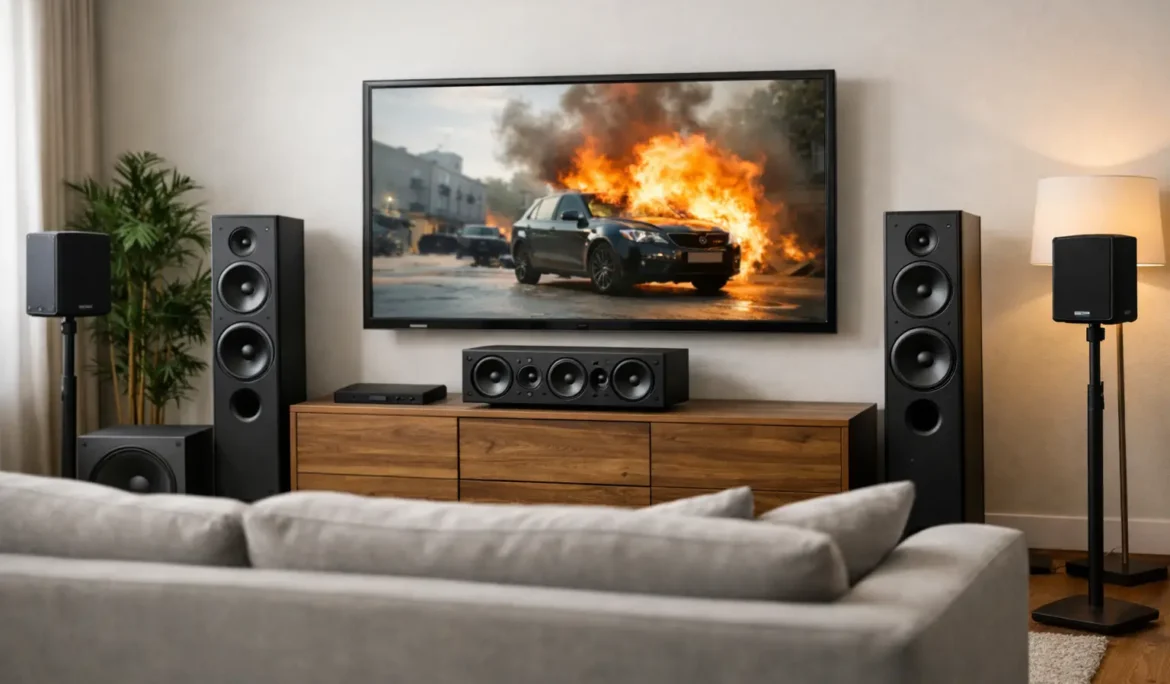
A great theater room can still sound disappointing if the speakers are in the wrong places. Surround sound speaker placement is what turns expensive equipment into a believable, immersive experience – where dialogue stays clear, effects move naturally, and bass feels controlled instead of boomy.
For many homeowners, the issue is not the gear. It is the room. Open floor plans, large sectionals, hard surfaces, fireplaces, and design constraints all influence how a system performs. That is why placement matters just as much as the speakers themselves, especially when you want a room that looks refined and sounds effortless every time you press play.
Why surround sound speaker placement matters so much
A surround system works by creating a soundfield around the main listening position. When speakers are too high, too wide, too close together, or blocked by furniture, that soundfield breaks apart. Instead of a cohesive movie experience, you get disconnected effects, weak imaging, and dialogue that seems detached from the screen.
Good placement solves several problems at once. It keeps voices anchored to the picture, helps front-to-back movement sound realistic, and makes the system feel larger without forcing the volume higher. In many rooms, thoughtful positioning can improve performance more than replacing components.
There is also a practical side. The best setup is not always the one that follows a diagram perfectly. Real homes have windows, traffic paths, décor goals, and seating layouts that require compromise. The goal is not mathematical perfection. The goal is convincing, comfortable sound in the room you actually live in.
Start with the main listening position
Before placing any speaker, define the primary seat or seating area. Every angle and distance should relate to that point. If your room has one dedicated row of seating, this is straightforward. In a family room with a sectional, choose the center of the most-used seats rather than trying to optimize for every corner equally.
This step matters because surround systems are built around listener geometry. If the television is mounted off-center relative to the seating, or if the sofa is pushed hard against the back wall, placement decisions become more limited. That does not mean the room cannot sound excellent. It simply means the design should account for those realities from the beginning.
Front speakers set the foundation
The front left, center, and right speakers do most of the work in movies and television. They handle dialogue, music, and much of the on-screen action, so their placement has an outsized effect on the final result.
The center speaker should be aligned as closely as possible with the screen. If it sits below the display, angle it toward ear level at the main seat. If it is installed too low and fires at your knees, voices can sound muffled or disconnected. This is one of the most common problems in living room systems.
The left and right speakers should frame the screen evenly and sit at roughly ear height when seated. In many spaces, a slight toe-in toward the listening area improves imaging and creates a more focused front stage. Too much toe-in can make the sound feel narrow. Too little can reduce clarity, especially in larger rooms.
Try to keep the front three speakers as consistent as possible in height and tonal character. When one speaker is tucked inside cabinetry, another is freestanding, and the center is buried on a shelf, the sonic balance can become uneven. Clean design and strong performance usually work best together when speaker placement is considered early, not after the room is furnished.
Where surround speakers should go
In a traditional 5.1 setup, surround speakers belong beside or slightly behind the main seating area, not all the way in the front corners of the room. Their job is to create envelopment, not compete with the screen channels.
A good starting point is to place the surrounds just above seated ear level. This helps effects spread through the room without drawing attention to a single speaker location. If they are too low, they can feel distracting. If they are mounted excessively high, the surround field becomes vague and less engaging.
For 7.1 systems, the side surrounds and rear surrounds need distinct positions. Side surrounds should still sit to the sides of the main listening area, while the rear surrounds go behind the seating with enough separation to create a sense of depth. If the back wall is very close to the sofa, rear speaker placement becomes more challenging, and it may be better to optimize a 5.1 layout properly than force a cramped 7.1 arrangement.
Dolby Atmos changes the conversation
Atmos adds height information, which can make a room sound dramatically more immersive when executed well. But it also increases the importance of speaker location. Height effects should feel intentional, not like generic sound coming from somewhere above.
If the room allows for it, in-ceiling speakers typically provide the most precise overhead experience. They create cleaner placement for rain, aircraft, ambient effects, and other height cues. Up-firing modules can work in some rooms, but their performance depends heavily on ceiling height, ceiling material, and room geometry. They are more sensitive to compromise.
Speaker placement for Atmos should also respect the base-layer speakers below. If the front stage is poorly positioned, adding height channels will not fix the underlying problem. It is better to build a strong foundation and then layer Atmos on top of it.
The subwoofer is about placement as much as power
Many people think the subwoofer can go anywhere because low frequencies are less directional. In practice, subwoofer placement has a major effect on bass quality. Move the same subwoofer a few feet, and the bass can shift from tight and balanced to bloated or nearly absent at the listening position.
Corners often increase output, which can be useful in larger rooms, but they can also exaggerate peaks and create muddy bass. Along a front wall is often a strong starting point, though not a rule. The best location depends on room dimensions, construction, and seating position.
This is where calibration matters. A properly placed and tuned subwoofer should support the room without calling attention to itself. You should feel impact when the content demands it, but dialogue and music should remain clean. More bass is not always better. Better bass is better.
Common placement mistakes in real homes
The most frequent problems are not complicated. Surround speakers are mounted too high because of aesthetics. The center channel is buried in furniture. Front speakers are pushed into corners. A large sectional blocks ideal speaker angles. Or the room is designed visually first and the audio is asked to fit wherever space remains.
Another common issue is assuming symmetry where none exists. If one side of the room opens into another space and the other side is a solid wall, the speaker layout and calibration may need to compensate. Sound does not care whether a floor plan looks balanced on paper.
Rooms with lots of glass, tile, and open surfaces can also sound brighter and less controlled. In those cases, speaker placement helps, but room finishes, furnishings, and acoustic treatment may be part of the bigger solution. It depends on how serious you want the room to be and how visible you want the technology to remain.
Placement should support both performance and design
For many homeowners, the best theater is not one that looks like a commercial cinema. It is one that fits naturally into the home, preserves clean sightlines, and works every day without fuss. That makes placement a design decision as much as a technical one.
This is especially true in multipurpose spaces where speakers, lighting, seating, and control systems need to work together. A well-planned system can hide complexity behind a simple, polished experience. That is often the difference between a room that gets admired and a room that gets used.
At Cine Acoustic, this is where professional planning adds real value. The right layout considers how the family uses the room, where the seating will actually stay, how the system should look, and how to deliver strong performance without making the technology feel intrusive.
When custom planning makes the biggest difference
Some rooms are forgiving. Others are not. If you are working with a renovation, new construction, a dedicated theater, or a design-sensitive living space, speaker placement is worth getting right before walls are closed and finishes are finalized.
That early planning can help avoid visible compromises later, such as awkward speaker locations, uneven coverage, or wiring paths that limit your options. It also creates better alignment between the entertainment system and the rest of the home, which is especially important when you want high performance without adding complexity to daily use.
The right room should sound natural the first time you sit down. You should not need to wonder why voices are hard to hear or why action scenes feel loud but not immersive. When the speakers are placed with intention, the technology fades into the background and the experience takes over.
If you are building a space for movie nights, sports, streaming, or everyday family use, the smartest move is to think about surround sound speaker placement before the room is finished, not after you start noticing what feels off.